Fresh bramble leaves to feed stick insects, we also supply fresh privet leaves and eucalyptus for stick insects to eat |Small-Life Supplies
 Est 1985 |
Small-Life Supplies |
|
|||
| ... for insect cages and living stick insects | |||||
| Small-Life Supplies |
Knowledge Base | Stick insect cages | Insects | ||||
 Clearance and sale items |
Insect cages for scientists |
Fresh leaves for stick insects to eat | Reviews |
||||
Food and drink for stick insects... |
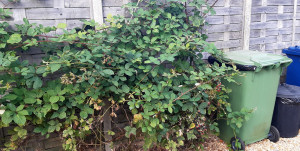 BRAMBLE (blackberry) leaves are eaten by most stick insects including: Indian, Pink Winged, Thailand, Vietnamese, New Guinea, Australian Macleays Spectre, Sabah, Guadeloupe, Sunny / Philippines. Gather bramble weekly from woods, overgrown areas, disused railway lines, or purchase Fresh Cut Bramble from Small-Life Supplies. |
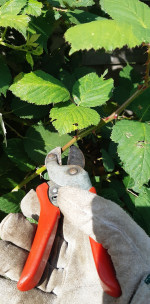 Snip two 40cm long sprigs of bramble (this is one week's supply for one ELC cage). Mist the leaves with water. |
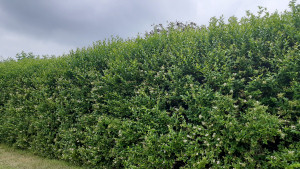 PRIVET leaves are eaten by Indian Eri silkmoth caterpillars and the Peruvian Black Beauty stick insects. Gather privet weekly from established privet hedges or purchase Fresh Cut Privet from Small-Life Supplies (when available). |
|||
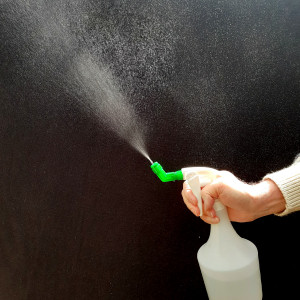 Mister Swivel  in stock
 |
Misters Stick insects drink water but it's best not to put a bowl of water in the ELC cage in case the stick insects drop in and drown. (There are a few exceptions and for these species of stick insect we supply shallow Water Dishes in two sizes). All stick insects like to drink water droplets from the surface of the leaves and it's recommended to lightly mist the leaves daily. It's really important that the water is dispensed as a fine mist and not a strong jet. So before dispatching our Misters, we set the nozzle to emit a fine mist and then perform several test sprays to check everything is set up and working correctly. Two types of Mister are in stock: The Mister Swivel has a directional green nozzle which you can swivel so that the mist of water is directed upwards, downwards, horizontally or at another angle onto the leaves. We use the Mister Swivel in our stick insect breeding facility because it is very effective and saves time. The Little Mister is a small blue sprayer, better suited for children to use. It sprays a mist of water horizontally only. Fill both Misters with ordinary cold tap water. Lightly mist the leaves (one or two squirts is sufficient) and try to avoid getting the actual stick insects wet! |
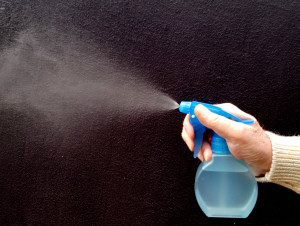 Little Mister |
|
in stock Please go to bottom of this
page for delivery and payment information. Please go to bottom of this
page for delivery and payment information. |
Mister Swivel ...£5.64 Little Mister ... £4.20 |
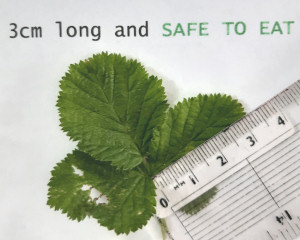 3cm long soft pale green bramble leaf |
Spring time
WARNING! During April the new bramble shoots appear. These leaves are small, pale green and soft. But these new leaves can be harmful to stick insects! So pull off the new shoots and discard them, and only give the stick insects the older, darker green leaves. The new soft pale green bramble leaves need to be a minimum length of 3cm long, before they are safe for your stick insects to eat. So have a ruler handy! For more information, watch our YouTube video: How to feed stick insects in the Spring |
|||
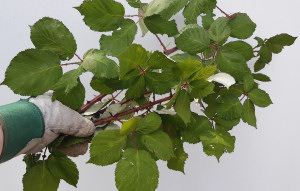 Fresh Cut Bramble (3 sprigs). |
Fresh Cut Bramble You receive three sprigs of Fresh Cut Bramble in a re-sealable wallet. Push the widest end of the stems into a Sprig Pot of cold tap water. Use what you need and place the remainder back in the wallet and store in the bottom of the fridge, where it will stay fresh for up to a week. Bramble (blackberry) leaves are eaten by most species of stick insects. However there are a few species that will not eat bramble leaves, so please contact us if you need to check that bramble will be suitable to feed to your stick insects. Mist the leaves daily with cold tap water, so the stick insects can drink from the water droplets on the leaves. |
|
in stock Please go to bottom of this
page for delivery and payment information. |
Wallet of Fresh Cut Bramble... £11.52 |
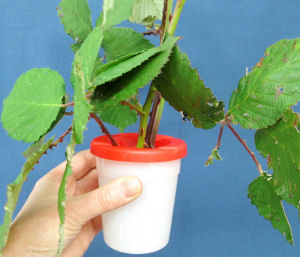 |
Sprig Pots The easy way to keep stems of foodplant fresh in water and prevent any stick insects from accidentally drowning. . Just fill with cold tap water and insert the sprigs of cut bramble or privet through the central hole. Plug any gaps with the cotton wool ball provided. This action stops any stick insects from dropping in the water and drowning. Sprig Pots are made in the UK and are dishwasher safe. |
|
in stock Please go to bottom of this
page for delivery and payment information. |
Sprig Pot ...£4.38 4 x Sprig Pots ... £16.98 |
 Fresh Cut Mixed Leaves (3 sprigs). |
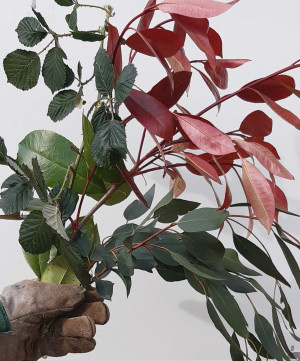
Fresh Cut Mixed Leaves You receive three sprigs of Fresh Cut Mixed Leaves in a re-sealable wallet. Push the widest end of the stems into a Sprig Pot of cold tap water. Use what you need and place the remainder back in the wallet and store in the bottom of the fridge, where it will stay fresh for up to a week. Included are sprigs of: Bramble (blackberry) leaves, Eucalyptus leaves and Photinia leaves. This combination is ideal food for medium sized nymphs and adult Australian Macleays Spectre stick insects (Extatosoma tiaratum) . Please note that very young Australian Macleays Spectre stick insects (under two months old) do best if fed exclusively eucalyptus leaves. To find out more, watch our You Tube video (# 004 "Feeding Australian stick insects in the UK"). Australian Macleays Spectre stick insects require less water than other species of stick insect, so only lightly mist the leaves once a week with cold tap water, so the stick insects can drink from the water droplets on the leaves. |
|
in stock Please go to bottom of this
page for delivery and payment information. |
Wallet of Fresh Cut Mixed Leaves... £11.52 |
DELIVERY
 |
SAFE ARRIVAL Items are delivered within mainland UK by courier. Safe arrival of goods is guaranteed and of course live arrival is guaranteed. We have been sending items since 1985 and always package items properly so that they arrive undamaged. We use both bespoke packaging and recycled packaging. FAST DISPATCH Items are in stock and dispatch is fast, usually within a few days. We let you know in advance what day delivery will be. On the day of arrival you can see what time delivery will be (within a two hour delivery window) by following the online tracking link. The driver can leave the parcel in your "safe place" if you may be going out. |
||||||||||||||||||||||||
DELIVERY PRICES Prices start at £4.98. If you order several items, the delivery price is usually capped at £9.96. See table for more details >>> |
|
||||||||||||||||||||||||
| Scottish delivery surcharges: The courier surcharges delivery to these Scottish postcodes: AB, DD, IV, KW, PA, PH, so please phone us on 01733 913480 if you live in these postcodes to request the total delivery price. |
| Payment Options... | |
| Phone
Small-Life Supplies on 01733 913480 to pay
securely by credit or debit card. |
 |
| To pay by
PayPal, email cindi@small-life.co.uk
stating what you'd like to buy, and your delivery postcode. We'll confirm your order by email and send you the PayPal invoice. |
 |
| To pay by
Bank Transfer, email
cindi@small-life.co.uk
stating what you'd like to buy, and your full delivery address. We'll confirm your order and email you our bank details. |
 designed by freepik |
| If you just
want to buy one ELC cage and/or the "Keeping Stick Insects" book, you
can order securely on-line anytime at the British selling platform
numonday.com https://www.numonday.com/shop/small-life-supplies |
 |
| Schools,
universities and companies can email cindi@small-life.co.uk and ask for a pro-forma invoice with the VAT breakdown. Payment can then be made by BACS, CHAPS, EFT, PayPal or card. |
 designed by freepik |
| Small-Life Supplies |
Knowledge Base | Stick insect cages | Insects | ||||
Clearance and sale items |
Insect cages for scientists |
Fresh leaves for stick insects to eat | Reviews |
||||
Please note that all photographs on this site are copyrighted by Small-Life Supplies and must not be copied or reproduced elsewhere.
Small-Life Supplies, Bassenhally Road, Whittlesey, Peterborough. PE7 1RR.