Taking care of stick insects, looking after stick insects | Small-Life Supplies
 Est 1985 |
Small-Life Supplies |
|
|||
| ... sharing our knowledge of correct insect care | |||||
| Small-Life Supplies |
Stick insect cages and enclosures |
Living stick insects ready now |
Clearance & sale items  |
Knowledge Base |
Lab Insect rearing cages |
About Us |
FAQs |
Reviews |
Email your insect questions to prof@small-life.co.uk Stick insect expert Professor Phasmid selects a few to answer every Friday.  Next questions to be answered on Friday 19th September 2025 |
The ELC cage is a good height, right? I've been doing my research and would like to just check that I need a stick insect enclosure more than 48cm high so my Indian stick insects will be happy.
Yes, the ELC stick insect cage is 51cm high, which is a really good height because it is nice and tall to give stick insects plenty of room to grow properly. Stick insects grow by sliding downwards out of their old skins, and so need a tall cage, at least 48cm high, so they have plenty of room to do this moulting (ecdysis) properly. Indian stick insects (Carausius morosus) do really well in the ELC cage, because as well as being the correct height it is also optimally ventilated (with two full mesh sides opposite each other, allowing for natural air-flow).
I'm getting Pink Winged stick insects and the ELC stick insects cage. I know they eat bramble leaves, but do I need to snip off the prickles?
All stick insects, including the Pink Winged stick insects (Sipyloidea sipylus) step around the bramble thorns and so no, don't waste your time in snipping these off. When your Pink Winged stick insects are adults, they will have large pink wings. Occasionally they flash these open for a few seconds in the ELC cage, and so it's important that the cage is not stuffed full of foliage which can snag their open wings. So just put one Sprig Pot containing two or three stems bramble (approx 40cm long) in the middle of the Liner on the floor of the cage, this allows plenty of free space near the cage sides. Most of the time the Pink Winged stick insects will be resting on the white mesh sides of the cage, and so if you follow this advice they can flash their wings with ease. It's best to take them out of the cage once a week for a short fly across the room. More details of how to do this are in the book "Keeping Stick Insects" by Dorothy Floyd.
Will Small-Life Supplies be at any insect fairs in the South East this year? I desperately need another ELC cage for my growing collection of stick insects and I enjoyed meeting you guys at the Kempton show, but that was many years ago now and I haven't been since.
No, Small-Life Supplies isn't exhibiting at the Kempton show or the other smaller events (these are mainly spider focussed). Our products are bulky and it's easier for customers to have the ELC cages delivered to their home rather than pick one up at a show and cart it around the hall. Our special offers are on our website "clearance page", so I recommend you check that regularly because sometimes a lightly used ELC cage is listed at a bargain price!
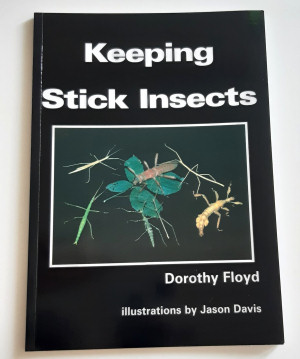
| The book "Keeping Stick Insects" by Dorothy Floyd answers
the questions most frequently asked, including details on the different
species, care tips and basic biology. Concentrating on the popular types of stick insect (Indian, Pink Winged, Thailand, Australian Macleays Spectre and New Guinea), this book is an invaluable practical guide, written by one of the UK's top breeders of stick insects. Available from this website: buy book from small-life.co.uk or 24/7 from our numonday on-line shop buy book on-line on numonday |
 10,000 copies sold |
||
| Our new stick insects arrived this morning, thank you so much, they weren't scared at all and crawled onto my hands straight away! They are four Indian stick insect adults and my son and I are delighted. Please can you tell me what the long elongated leaves are that were sent with them? It's great that your Indian stick insects (Carausius morosus) are lively and are already confident in their new home. The Indian stick insects that are sent out by Small-Life Supplies are always packaged with plenty of food, which includes their favourite food of nice green bramble (blackberry) leaves, and also a long stem of eucalyptus , which has the long elongated leaves to which you refer. It's really important that you continue to feed your Indian stick insects with bramble (blackberry) leaves. You can also add hazel leaves, rose leaves and eucalyptus leaves if you wish, but these are not essential and most people feed their Indian stick insects solely on a diet of bramble (blackberry) leaves because this suits them the best. I'm a lab technician, just started at a new school and have been tasked with setting up the stick insect cage in the biology lab. It's an empty ELC stick insect cage and so I will need the Liners, Sprig Pot, Mister and a couple of species that would spark an interest in the boys (aged 12-16), what do you recommend? The feedback we have from secondary schools that keep stick insects is that it is the most lively stick insects that are the most popular. And so I'd recommend the Thailand stick insects (Baculum thaii) , these are supplied in pairs of males and females, and the adult males are particularly active! Thailand stick insects also have the advantage in having a very quick incubation time for the eggs, with the eggs hatching after 4-8 weeks. This is a lot faster than other species of stick insects where the incubation time is months. And adding four adult Indian stick insects (Carausius morosus) to the same cage housing the Thailand stick insects works well. The two species look completely different and the Indian stick insects move at a slower pace and have a "party trick" of clamping all their legs together and falling into a straight stick! School topic ideas are given in the "Keeping Stick Insects" book by Dorothy Floyd, which has whole sections on both these species. Thailand stick insects and Indian stick insects both eat bramble (blackberry) leaves which you gather from overgrown areas outside (or you can purchase wallets of Fresh Cut Bramble from Small-Life Supplies). What’s the best way to get rid of stick insect eggs in the UK please? I've saved some but don't want to save too many! Boiling water is the fastest way to stop stick insect eggs from developing and this method is 100% effective and humane. Most stick insect eggs take months to develop and so it's best to dispose of unwanted eggs soon after they have been laid. Tip the surplus eggs into a bowl, boil a kettle, pour the hot water over the eggs and let the mixture cool before throwing it away. Do stick insects need to be kept in an especially hot room? Would 18 degrees be OK? One big advantage of keeping stick insects is that they do not need extra heating (unless your room is very cold). Our commercial stick insects breeding area is set at a daytime temperature of 18°C and a nighttime temperature of 14°C. Many homes and schools in the UK are between 18-21 degrees Celsius during the day and that range is fine for keeping stick insects successfully. So, at 18°C your room is at a perfect daytime temperature and is very unlikely to get too cold at night. However, for the few people who are living in properties that are routinely below 18°C during the day and below 12°C at night, the best way of keeping the stick insects warm is to use a portable 500 Watt oil-filled radiator. Just plug this into a wall socket near the ELC cage of stick insects and benefit from the gentle warmth emitted safely, and at low-cost from this device. To purchase a 500W oil-filled radiator that plugs in, please visit buy 500W oil-filled radiator portable Is it true that New Guineas stick insects are ground dwelling? No. The reason why this myth is perpetuated is because New Guinea stick insects (Eurycantha calcarata) like to group together by piling on top of each other, and an obvious place to do this is on the floor of the stick insect cage underneath loose leaves (which they deliberately cut off the main stem). However, if you provide a hiding area at the top of the cage, the New Guinea stick insects will congregate there. Similarly if you create a hiding area on the side of the cage, that is where the New Guinea stick insects choose to rest, proving that it is the hiding area that they are seeking out, regardless of where it is. When you purchase New Guinea stick insects from Small-Life Supplies, you receive a resting tube which you can position wherever you like in the ELC cage. Most people place it on the ELC cage Liner, and of course the New Guinea stick insects will congregate inside it during the day. But this does not mean they are ground dwelling, and at night when it is dark, the New Guinea stick insects are very active and walk up and down the mesh sides of the ELC cage, hooking their large claws around the holes to get a good foothold for walking. I was just checking my Carausius morosus eggs and I saw a very tiny baby freeing her back end from her egg, which at that time was exactly where it was before the hatch began. The baby looked much smaller than the babies I’ve discovered before, and her legs looked long and spindly until she started to walk. Did I witness the end of the hatching process? The photo was taken just minutes after she became free, and she did not get stuck. Yes, you have been lucky enough to witness the end of the hatching process. The freshly emerged stick insect (called a first instar nymph) looks slightly comical because she is out of proportion for the first ten minutes or so of her life. So although her legs are the normal size, her body isn't and she needs to expand her thorax and abdomen quickly whilst her exoskeleton is still soft. Most Indian stick insects (Carausius morosus) hatch at night and so when people see the babies in the morning, they are all the correct size. Which creatures eat stick insects in their native habitat? Wasps are a main predator of stick insects. Birds also eat stick insects in the wild. I have felt nervous about having a mixed sex group of Sun Beetles in the ELC cage. How many eggs would I be dealing with with a mixed sex group, and how many beetles would I be ending up with? Would it become unmanageable? I have a space next to a radiator and window. Or there is another space that´s about ten feet from the window and radiator, which would be best? What´s the best and safest way to source the objects they need for hiding and climbing, like the twigs mentioned in the advice sheet you shared? Can these just be gathered? Your second suggested place would be best, so away from the window and radiator, because this minimises the chance of the beetles being exposed to extreme fluctuations in temperature. Place the ELC cage on a small table, rather than on the floor which would be too draughty. Adult Sun beetles (Pachnoda sp) usually rest on the white mesh sides of the ELC cage, but you can also add some buddleia twigs for extra decoration if you wish (these are available free from Small-Life Supplies when other items are purchased). The adult Sun beetles mate regularly throughout their lives and the females bury their shiny white eggs in the dish of damp soil. They don't lay huge numbers of eggs (tens rather than hundreds), not all the eggs hatch and not all the grubs survive, so you are very unlikely to be overrun. The eggs are really obvious and so if you don't want to try breeding any more, just spread the eggs out on kitchen roll and they will very quickly dry up inside and stop developing. (This is the same 100% effective technique recommended for controlling unwanted Giant African Land Snail eggs.) Any eggs you keep will take weeks to develop and the emerging grubs (that live in the soil) take months to grow, so it will be a while before you can enjoy seeing the next generation of adult yellow and black beetles emerge. Do Indian stick insect eggs need to be kept damp? No. The easiest way to incubate Indian stick insect eggs (Carausius morosus) is to store them in an unventilated clear container and just be patient. Hatching usually occurs after four months, but this can be reduced to three months during hot summers. One joy of keeping Indian stick insects is that their eggs are so easy to hatch and don't need any attention during the months of incubation. The best unventilated container to store the eggs is the clear HAP pot, these are specially made by Small-Life Supplies and are ideal for storing stick insect eggs and also housing the baby stick insects (called first instar nymphs) when they hatch. When the stick insect hatches out of the egg, she is thirsty and so it's important to give her a wet bramble (blackberry) leaf to drink off. Asking this on behalf of my friend as one of his Indian stick insects ate a chunk of his Calathea that had some plant fertiliser around a week ago, he’s worried that it may poison the stick insect. Photo attached. Calathea plants are also called the Prayer plant Maranta, and are OK for Indian stick insects (Carausius morosus) to eat. I can see from your photo that she has eaten a large chunk out of a leaf! Liquid plant fertiliser such as Baby Bio is a good fertiliser for houseplants and will not harm an insect that eats the leaves. So your friend does not need to be worried, because his stick insect will be fine. You could tell him that stick insect frass (the poo/droppings) contains nitrogen and is an excellent fertiliser for houseplants. Just pour the frass into a jug, add hot tap water and allow the mixture to stand for a day or two to cool and dissolve. Then stir well, and pour over the soil around the houseplant. I have been doing this for years and know that it definitely works! I was reading about erythrism, a genetic mutation that increases red pigments (carotenoids and related compounds) whilst reducing green pigment (biliverdin). A classic example of this is pink grasshoppers! The mutation is recessive, meaning both parents must carry the gene for it to appear in offspring. That’s why pink individuals are rare, often estimated at around a 1% chance of being seen in a person’s lifetime. I've never been lucky enough to see one, have you? Yes, I remember seeing a pink grasshopper in France years ago during a family holiday picnic! I took a photo of this pink grasshopper and had this photo enlarged when I got home because it was so unusual. Two days ago I got two Black Beauty stick insects and have set up the vivarium with substrate (orchid bark) and fake plants. Now, the female can’t open her legs fully which is making her fall onto her back. She won’t eat but is trying to drink. Is she trying to shed her skin? Video attached. Unfortunately your female Black Beauty stick insect (Peruphasma schultei) is dying, because she has been poisoned. Your set up is not ventilated enough and it is a bad idea to include fake plants and substrate because the artificial chemicals released from these (either airborne or through being consumed) can kill your stick insects. Her behaviour indicates her nervous system has been damaged which is why she has lost co ordination of her legs. She has wings and so is fully grown so would not shed her skin again (stick insects shed their skins as they grow, but when fully grown never shed their skins again). She cannot recover from this and so the kindest thing to do is to place her on a wet privet leaf because dying stick insects like to drink, and she will pass soon. To give your remaining male stick insect a chance, you should replace the substrate with paper and remove all the fakery. Then you need to find a well established privet hedge and cut some fresh pieces. Never use potted privet plants because these are likely to contain pesticides that will kill your stick insects. And moving forward, a larger, more ventilated enclosure would be much better housing, so please consider the ELC stick insect cage because this enclosure is the best housing for most stick insects, including Black Beauty stick insects. I want to order pet stick insects on-line at Small-Life Supplies, but am unsure which type to choose? Can you help me please? Free friendly stick insect advice is available from Small-Life Supplies, so please contact us directly during weekday office hours between 9am and 6pm. Chatting over the phone is best, the number is 01733 913480. Or you can email cindi@small-life.co.uk. Or go to the Small-Life Supplies Facebook page and get in touch using Facebook messenger. The stick insects that Small-Life Supplies breed and supply are chosen because they are safe breeds to keep and respond well to handling. Which type(s) you choose depends on your personal preference as to whether you prefer a really thin one, such as the Thailand stick insect (Baculum thaii). Or maybe you prefer the look of a chunky prehistoric one, such as the New Guinea stick insect (Eurycantha calcarata)? Undoubtedly the easiest type to start with is the Indian stick insect (Carausius morosus), and these also have the advantage that you can add Pink Winged stick insects (Sipyloidea sipylus) and/or Thailand stick insect (Baculum thaii) to the same ELC cage at a later date, as your interest develops. They all eat bramble (blackberry) leaves, which can be gathered from blackberry bushes growing wild outdoors all year round in the UK. What is best to help the enclosure look like a natural habitat? Fit our "Dappled Glade Background" sheet onto the back of the ELC cage to create a natural looking environment and use the green ELC Liner on the floor of the enclosure. This creates a naturalistic look whilst also maintaining clean and hygienic surroundings. Avoid using soil and earth on the cage floor because this soon becomes damp and encourages mould and small flies, as well as making it very difficult to control the number of eggs you keep. Inserting plastic plants and decor can be risky too because new products can release a smell and stick insects are very sensitive to artificial smells. You can insert twigs, but make sure you thoroughly check them first and remove any spiders that may be hiding. Ensure there is not too much clutter in the cage because the stick insects prefer to shed their skins on the mesh walls and need plenty of clear space underneath so they can complete each skin change (ecdysis) successfully. Always ensure there are fresh long stems of foodplant (usually bramble sprigs) in the Sprig Pot of water, but there is no need for the leaves to be touching the top or the sides of the cage. My daughter was given a pot of Sunny stick insect eggs and she's been anxiously checking on them for months. Today we have three that have hatched! I've gone on Marketplace and bagged myself an ELC cage, which I have just collected. I attach a photo, have I set it up correctly? And what do I do about giving them water? Like most other species, the baby "Sunny" stick insects (Sungaya aeta) do like to drink water from the water droplets on the leaves, So it's important to lightly mist the leaves (don't get the stick insects wet!) so these stick insects can have a drink. When they are little, the Sunny stick insects prefer less ventilated conditions, and so need a much smaller enclosure. The HAP pot is ideal, and when you insert a wet bramble leaf, it stays wet for a while because the HAP is not ventilated. Small-Life Supplies breed various species of stick insects, and many of them do best in unventilated surroundings for the first few weeks of their lives, and then need the larger ventilated surroundings of the ELC cage as they grow. That is why the HAPs have been specially made by Small-Life Supplies and are the perfect nursery enclosure for various species of young nymphs, including the Sunny type and also, of course then popular Indian stick insect (Carausius morosus). It's great that you have got an ELC stick insect cage because this can house your Sunny stick insects in the autumn, when they are larger and need more ventilated surroundings. If you'd like to purchase disposable ELC Liners or the new naturalistic background for the ELC cage, please contact cindi@small-life.co.uk Has the size of the ELC stick insect enclosure changed over the years? There has been no shrinkflation on ELC stick insect cages. So the ELC stick insect cage is exactly the same size now as it was when this enclosure was launched in 2012, thirteen years ago! That means you can purchase the disposable ELC Liners (in blue, green, and pink), safe in the knowledge they will still fit the floor of the cage, regardless of when you purchased it. And you can now purchase our unique naturalistic background (called the "Dappled Glade Background"), confident it will fit behind the clear back panel of the ELC cage! The engraved label on the lift-off lid of the ELC cage indicates the year that particular cage was manufactured. All ELC cages are still manufactured by Small-Life Supplies in the UK. Saw the new Australian stick insect identified by Professor Angus Emmott in the news today. Looks like an Acrophylla wuelfingi to me, so I'm not sure what the excitement is about? This new Australian stick insect is attracting so much publicity because of her total length (40cm) and weight (44g). She is an adult female and has been assigned a new species of Acrophylla alta. However, as you state, her physical characteristics are very similar to those of the established Acrophylla wuelfingi stick insect (also called the Acrophylla titan stick insect), and indeed that species is also found in the tree canopies in Queensland, Australia. The researchers have examined the eggs from this newly found stick insect, so presumably they are physically significantly different from those eggs produced by Acrophylla wuelfingi , which is why they have designated it as a new species. And of course, the Acrophylla wuelfingi adult females are generally not quite as long, the usual total length is 33cm, so longer than a ruler! I used to breed Acrophylla wuelfingi and, as with other large species of stick insect, there is a lot of variation amongst the final total length that the adults achieve, both in captivity and in the wild In the "Bulletin of Entomological Research" issue 74, pages 633-640, there is an interesting aphid research paper regarding the population change in Myzus persicae overwintering on spring cabbage in the UK in relation to meteorological and biological factors. The Clip Cages used for this research seem to be the same design as the ones that Small-Life Supplies sell? I hope they are because I would like to replicate this field experiment. Yes, the Clip Cages that Small-Life Supplies manufacture and sell are the classic design that has been used by scientists for decades, and are the same dimensions. This is so scientists can replicate existing published work, or conduct new research work using the same apparatus, so making the experiments scientifically robust (because the variables are minimised). Is it true that if you breed a parthenogenetic chain for too many generations, they become weak and unhealthy? I have new Carausius morosus eggs and wondered if there was a limit to the number of generations you can have before their health was compromised? One advantage with parthenogenetic reproduction is that a heathy strain can continue forever. All the Indian stick insects (Carausius morosus) that Small-Life Supplies sell are descended from just one Indian stick insect that laid eggs in 1976! For years, some scientists had the view that parthenogenesis could only continue for a few generations, but that opinion has now been proven to be false, and indeed our Indian stick insects are still going strong, fifty generations later! Sometimes an unhealthy parthenogenetic stick insect lays eggs and if these eggs are saved the resultant offspring will be genetically weak. In these circumstances, the descendants from that stick insect die out after a generation or two. When keeping stick insects as pets, it's best to only save eggs from healthy looking adults. Please see the Small-Life Supplies YouTube video to see what healthy adult Indian stick insects should look like. Healthy stick insects look like this, video # 011 I've looked for stick insects for sale near me but would prefer to purchase from an expert breeder who knows their stuff. Can I collect stick insects and enclosures from Small-Life Supplies or must they be delivered? It's better to purchase direct from a long established breeder who knows about the creatures and proper care, rather than from a general pet or reptile shop who may not have this specific knowledge about stick insects. Small-Life Supplies has been breeding stick insects and manufacturing and supplying proper insect cages for forty years and are now considered world class in this area. The business delivers items nationwide to mainland UK and live arrival is guaranteed. Collection is not possible, but everything is really well packaged, and customers are updated with the delivery of their order including what time it will arrive (within a two hour time window). I have unfortunately lost 6 of the 8 Indian stick insect nymphs in my batch with the genetic growth disorders. My strongest remaining stick is 8 weeks old and completed her third moult at the weekend, now measuring around 3.5cm, slightly bigger than any of the others ever reached. From her appearance, is there a chance she could avoid arrest and complete her growth, or is she more likely to have the same fate as her sisters? Her appetite and behaviour is normal. Her same age sister is in the picture for comparison. It's looking promising for her, because a total length of 3.5cm at age of 8 weeks is perfect for a healthy Indian stick insect (Carausius morosus). I can see from the photo that both of your Indian stick insects have broken antennae, which is unusual and indicates the genetic stock is of poor quality, which you already know. The prognosis for her smaller sister is not good, but the larger stick insect should be able to grow normally (damaged antennae do not slow down the growth rate). I've just received my ELC cage and am currently debating on what stick insect to go for. I was seriously considering getting Eurycantha calcarata but have discovered that they can pinch with the sharp spine on their back "thighs". Is this true? I am also considering getting Sungaya inexpectata, but as a complete beginner, is there anything I need to know before getting this particular species? Like many insects, New Guinea stick insects (Eurycantha calcarata) have the ability to defend themselves if they are being attacked or seriously provoked. Sadly, there are unkind people who think it is funny to repeatedly hit a New Guinea stick insect in order to provoke such a defensive reaction which they can film and post online. And unfortunately many people are also blissfully unaware that New Guinea stick insects need to drink a lot of water, so it's essential to put a dish of water into the cage. Failure to do so results in New Guinea stick insects becoming very stressed and agitated. Of course when you purchase your New Guinea stick insects from Small-Life Supplies, you can be confident that the stick insects you receive will be healthy and have calm temperaments. Care advice is included and more detailed information on the New Guinea stick insects (and other popular varieties) is in the book,"Keeping Stick Insects" by Dorothy Floyd. Sungaya inexpectata (a parthenogenetic species) and the more commonly available Sungaya aeta species, (which has an equal ratio of males and females) are pretty stick insects, but aren't the most responsive and spend a lot of time on the floor of the cage. In contrast, the Indian stick insect (Carausius morosus) respond well to handling and are by far the best choice for a complete beginner. Can stick insects let off bad smells? Only a few species of stick insect can emit a bad smell, this is a defensive action and is only done when the stick insect feels threatened. The airborne molecules soon disperse and so the smell goes away after a few minutes. Popular species such as the Indian stick insect (Carausius morosus) and Thailand stick insect (Baculum thaii) cannot do this and so are completely odourless. However, the Thailand Straight stick insect, aka Bud Winged stick insect (Phaenopharos herwaardeni), can emit a strong smell when frightened, as can the Australian Macleays Spectre stick insect (Extatosoma tiaratum). It is important to distinguish these general smells that are harmless, from the handful of dangerous species of stick insect which produce a harmful chemical spray and actively direct this at the eyes of people and pets, capable of causing temporary blindness. Small-Life Supplies is an ethical business and does not breed or supply such dangerous species of stick insect. We'd like some stick insects for the summer holidays, to watch them grow. We've decided on Pink Winged stick insects and Thailand stick insects, they'll both be OK in the ELC cage, right? Our allotment has loads of bramble, so no issue with food supply! My son wanted to know if the Green Bean stick insects would also eat bramble? That's a great summer project, and yes, two Pink Winged stick insects (Sipyloidea sipylus) and four Thailand stick insects (Baculum thaii) live together happily in the ELC cage. Both those species eat bramble (blackberry) leaves and this grows well in allotments. Our Grenadan Green Bean stick insects (Diapherodes gigantea) ignore bramble in favour of eucalyptus leaves, and so no, I would not recommend bramble for that species, it is better to feed Grenadan Green Bean stick insects with eucalyptus leaves. Ooh, you've got the Macleays Spectre stick insects listed! I think these are so cute, but have heard horror stories about the virus that is killing them off. How can you tell if the stick insect is healthy or not? Yes, there is a virus that can affect the Australian Macleays Spectre stick insects (Extatosoma tiaratum). Fortunately it is not present in the breeding stocks of stick insects at Small-Life Supplies. It's really easy to spot if a stick insect is affected just by a visual inspection. Healthy Australian Macleays Spectre stick insects routinely curl their tails up (this is a defensive behaviour to pretend they are dangerous scorpions). But ill Australian Macleays Spectre stick insects, that are suffering from the virus, are unable to do this and drag their bodies flat behind them. There is no cure for these afflicted stick insects and they die within weeks. It is very depressing to see some stalls selling these ill stick insects at invertebrate fairs. I have been desperate to keep Pink Winged stick insects ever since seeing them at a nature place two years ago! They are so beautiful with their fairy like wings. I am so glad that you have them in stock. But here's the thing, I am away on holiday until 8th August, is there any way I can buy them now and have them delivered when I get back? Yes, of course, just mention this when you order and it can be arranged. Small-Life Supplies breed Pink Winged stick insects (Sipyloidea sipylus) in large numbers and are happy to accommodate customer's delivery requirements. Help please! Our two grandchildren are visiting us for three weeks next month, so we are planning activities that are affordable. I am keen to encourage their interest in nature and so will be getting some stick insects from yourselves, I know Cheyenne will love the New Guinea stick insects, but I think Aria would prefer the Thailand stick insects. So that means two ELC cages, any chance of a discount? It is great to hear that you are encouraging your granddaughters to be interested in stick insects. And although some species can be mixed together in the same ELC cage, it is not recommended to mix a chunky bulky type like the New Guinea stick insect (Eurycantha calcarata) with a thin bodied sort such as the Thailand stick insect (Baculum thaii), in case of accidental damage. (A chunky stick insect can accidentally harm a thin stick insect by treading on it). From time to time, Small-Life Supplies sell lightly used ELC stick insect cages at a discount rate, so I recommend you visit the "clearance" page on this website, or phone Small-Life Supplies on 01733 913480 before 6pm. Are stick insects for sale all year? Or is it seasonal? Small-Life Supplies sell stick insects all year. Live arrival is guaranteed and so sometimes there may be a slight delay due to very hot weather or extremely cold weather. The conditions must be favourable for the stick insects to travel safely and so the weather can't be too hot or too cold. Customers are updated by email with the delivery details . I've been told that some moths can fly from Africa to the UK, but is there proof of this? Yes, this was proved decades ago. In February 1960, the French government undertook nuclear testing in the Sahara. The following month the eminent entomologist Dr Kettlewell tested the moths caught in his moth trap in Oxfordshire, UK with a radiation detector. He found a specimen of the Rush Veneer moth (Nomophila noctuella) contained a radio-active particle that came from the explosion. This confirmed the moth had flown the 1500 miles from Africa to the UK. I've recently retired and would like to learn more about insect physiology. There seems to be a plethora of dumbed-down information on this subject on-line, and so I am hoping you can recommend a good book on the subject, written by an expert in this field? I recommend the book "Insect Physiology" by V.B.Wigglesworth, this is a concise 166 page paperback and written in a clear style. The author was based at Cambridge University, UK for years and was a leading authority on the subject. How long do Indian stick insect eggs take to hatch in summer? I got some eggs from a new source that were laid in early June and it has been warm since then. Also, I have a couple of eggs from the old group that were laid in March. They haven’t sped up because of the heat, so are they probably duds? In hot summers, the incubation time for Indian stick insect eggs (Carausius morosus) can reduce from four months to three months. It has been extremely hot in the UK recently and at Small-Life Supplies the Indian stick insect eggs laid on 22nd April 2025 are hatching now (so after slightly less than three months). If you have noticed your eggs hatch sooner in hotter weather, then I agree your March eggs are probably duds. I was gifted a round net enclosure with ten stick insect eggs. So far four have hatched, but they have all died. What am I doing wrong, I was told Indian stick insects are super easy to look after? I attach a photo. Baby Indian stick insects (Carausius morosus) prefer non-ventilated surroundings and so we recommend housing them in a container without airholes, such as the HAP. Also, baby stick insects are thirsty and so it's important to give them a wet bramble (blackberry) leaf, so they can drink from the water droplets on the leaf. We start off rearing all our Indian stick insects this way and have an almost 100% success rate. As the stick insects grow, they require more ventilation, and so it's best to transfer them to the ventilated ELC stick insect cage when they are 4 - 6 weeks old. The method you are using is not one we would endorse, so I urge you to change it asap so that when your remaining eggs hatch, those baby stick insects have a decent chance of survival. Indian stick insects do best if they eat bramble/blackberry leaves (in general, ivy is usually regarded as a foodplant of last resort). Can you get aquatic stick insects? There is a "Water stick insect" which occurs in the UK and lives in ponds and lakes. However, this insect is classified as belonging to the order Hemiptera and has the Latin species name Ranatra linearis. Terrestrial stick insects belong to the order Phasmida and so in taxonomic terms, the aquatic water stick insect is no relation to the terrestrial stick insects. We have some Vapourer Moth eggs, laid in April and May of this year, but none have hatched? We are seeing lots of butterflies in the garden, also hoverflies and ladybirds, and so it seems strange that we have no Vapourer caterpillars yet? Eggs of the the British Vapourer Moth (Orgyia antiqua) have the ability to hatch when they register conditions to be favourable. In the UK at the moment, conditions are not favourable for these caterpillars because it is too hot and dry. So it is good that the hatching of the eggs is being delayed. As the summer progresses and hopefully cools down a bit, the eggs should start to hatch. Meanwhile, the very hot and dry weather has lead to bumper populations of the insects you mention and also Elephant hawk moths. How can I keep my Indian stick insects cool in this heatwave? I have four Indian stick insects in one ELC cage. Indian stick insects (Carausius morosus) do not like very hot surroundings and struggle when the indoor temperature is above 25 degrees Celsius. The best way to cool down the ELC cage containing Indian stick insects is to place a frozen blue freezer block on the roof of the ELC cage because this lowers the temperature by a couple of degrees. Combine this with taking other actions to reduce the room temperature (Open the windows before 7am to let cooler air in. Then shut the door to that room and close all windows and blinds/curtains to minimise solar gain). Indian stick insects do best at a daytime temperature of 18 - 21 degrees Celsius, they can tolerate slightly higher temperatures for a short time, but really struggle when it is above 25 degrees Celsius. Some dude said his stick insects died because the parthenogenetic chain went on too long - is this true? No, it is a myth that a parthenogenetic species of stick insect have evolved to only reproduce for a certain number of generations and then die out. All the Indian stick insects (Carausius morosus) that Small-Life Supplies breed and sell are descendants from one Indian stick insect who lived back in 1976! So there have been dozens of generations from that stick insect, and these Indian stick insects are in excellent health. Can different stick insects live together? Some species of stick insect can be mixed together, but others not. It depends on their ventilation requirements, so you can mix types that like airy surroundings together, but it would be unwise to house a species that prefers less-ventilated surroundings with one that likes airy conditions. Also it is not recommended to house a big chunky heavy stick insect with a thin delicate stick insect, in case the latter is accidentally trodden on! You can safely house Indian, Pink Winged and Thailand stick insects altogether in the ELC cage. Are we allowed to keep stick insects in school? Yes, many nursery, primary and secondary schools in the UK keep stick insects successfully in the classroom or lab. Having living stick insects at school is a great way to spark an interest in biology and the natural world. The stick insects are very low maintenance requiring a weekly change of the Liner in the ELC stick insect cage and the bramble sprigs replenished with fresh leaves. Only keep the safe species, Small-Life Supplies are reputable and so only supply the harmless species of stick insect, so the students (and teachers) are not at risk. CLEAPSS can advise on how to answer the admin risk assessment forms, if required. Ensure the room housing the ELC cage of stick insects is above 14 degrees Celsius at night during the winter months, and approximately 21 degrees Celsius during the day, because these are the temperatures that our stick insects are used to and which suit them best. Does Small- Life Supplies sell stick insects to regular people? Or just to universities and big organisations? Regular people are very welcome as customers, so please reach out to us if you'd like some stick insects for your home. Stick insects make great pets for people of all ages too. We're happy to advise which species would be right for you so please phone 01733 913480 for a friendly chat to discuss the options. I listened to the live on-line talk by Dr McAlister on flies, but didn't understand the part where she said flies don't bite? Every year we get eaten alive by midges here! Am I missing something? She was emphasising that flies have sucking mouthparts, so when a fly such a female mosquito attacks a person, she can jab and pierce a person's skin, but this is not technically defined as a bite. However, I think most people who react with the characteristic raised skin rash following this experience would say they have been bitten by a mosquito! Also there are the Biting Midges (150 British species), family Ceratopogonidae, which do have proper biting mouthparts and can suck the blood out of mammals and birds. My oldest Indian stick insect is just over 3 months old and is 3cm from head to tail. Last week she had constipation for a few days needing gentle help (one even got to half her size before passing). She last moulted 26 days ago and seems to have put on a tiny bit of weight, but she seems smaller and thinner than my previous 4th instars. From the photo, does she look anywhere near shedding? She has a big appetite and can still stand tall, but hasn’t changed in appearance. Could this be a hopeful sign of an upcoming moult or is she gradually reaching the end? Thank you for the photo of this Indian stick insect (Carausius morosus). Sometimes a stick insect does not grow at the normal rate because of hormonal issues and this appears to be what is happening here. Growth is arrested because the hormone triggering ecdysis is not being released. Such stick insects usually die before reaching maturity, but are not suffering, so I suggest you continue to look after her and perhaps offer her some additional types of leaves, such as Red Robin (Photinia) , hazel or wild rose, because these may help with her digestive problems. It appears that your culture of Indian stick insects has various genetic issues and so, moving forward, I recommend you get a new batch of eggs. Small-Life Supplies do sell Indian stick insect eggs (in packs of eight) and these are from our very healthy indivuals, so please email cindi@small-life.co.uk for more details. Are stick insects becoming more popular? Yes, stick insects are now very popular pets in the UK. The actual stick insects and correct enclosures can be purchased from Small-Life Supplies. Stick insects are easy to look after, just feed them once a week with fresh bramble leaves, standing the cut stems in a Sprig Pot of water so that the leaves stay fresh. And you can mix certain types of stick insect together in the same ELC cage to make an interesting display. I’m stoked that you have directions for raising Diapherodes. But there are more that 100 species of eucalyptus. Can you narrow it down? I am living in California,USA, where a few species of eucalyptus have naturalized. We use Eucalyptus gunnii leaves to feed the Green Bean Grenadan stick insect (Diapherodes gigantea). Here in the UK, that species of eucalyptus is very easy to grow outside. Initially the leaves are round but as the tree matures, it produces elongated leaves. The newly hatched Grenadan stick insects prefer to eat the soft tender new growth eucalyptus leaves, and can do so without any adverse effects. This is in complete contrast to young bramble leaves (eaten by other species of stick insect) that, if eaten, can cause health issues for the stick insect and so are best avoided. I want another ELC cage for my Macleays Spectre stick insects, this will be my third! Do you have any cut-price ELC cages in stock now, or maybe in the near future? I've seen one on Marketplace for £50, but sadly it's nowhere near me. The ELC cage is great for housing the Australian Macleays Spectre stick insects (Extatosoma tiaratum). And yes, there is one just listed on the "clearance page" of www.small-life.co.uk, it has been lightly used and is for sale at a bargain price. Our used ELC cages usually sell very quickly, so I'd recommend you phone Small-Life Supplies on 01733 913480 to check availability. Is Small-Life Supplies going to be exhibiting at the Cambridge museum insect event on Saturday 21st June 2025? This is a general information event about insects, held at the Zoology Museum, Downing Street, Cambridge. CB2 3EJ. And in the lecture hall there will be talks by museum staff who work with insects. It's free to visit and the RSPB and Wildlife Trust have stands, but there won't be firms like Small-Life Supplies present. One of my 6 stick insects passed suddenly the other day which I presumed was a bad molt, it dropped to the floor while I was misting, after resting on the mesh for days, and couldn’t get up, was unresponsive to touch and legs were limp. Today I've noticed a second stick insect is similar, hanging off the mesh sideways, its legs are limp and seems weak, and very mildly responsive. I put some water on a leaf and rested it on its leg to help if its dehydration. Nothing has changed in their care and they hatched end of February. They are misted every few days and every other day when it’s warmer. My other 4 seem okay and are behaving as normal. Help please! Thanks for the photo, I can see they are adult Indian stick insects (Carausius morosus) in a netting enclosure, eating ivy leaves. Indian stick insects go limp and die when it is too hot, so it is really important that you move them to a room that is approximately 18 - 21 degrees Celsius during the day, and cooler at night. In the UK, we are having very hot weather just now, it is 28 degrees Celsius outside. When the temperature indoors exceeds 25 degrees Celsius, Indian stick insects are at risk. You can cool the ELC cage down by placing an ice pack on the solid roof, but this is much harder to do with a round netting enclosure. Moving forward, it would advisable to also put some bramble in the cage for your Indian stick insects to eat because they often prefer bramble to ivy. It doesn't matter if you've fed them ivy from birth, they can switch to eating bramble at any time. We are getting four Australian Macleays Spectre stick insects and the ELC bundle delivered to us next week, but I need to know more about how to feed them. Specifically: how much bramble do we give them, how long should the stems be, do they bend over and need supporting, and do the leaves need to touch the sides of the ELC cage so the stick insects can easily climb onto the leaves? Australian Macleays Spectre stick insects (Extatosoma tiaratum) thrive in the ELC cage and can eat both bramble (blackberry) leaves and eucalyptus leaves. Cut two 40cm long bramble sprigs (stems with nice green leaves attached) and push both cut ends through the central hole in the red lid of the Sprig Pot (fill this with cold tap water first, as per the instructions supplied). The bramble sprigs are strong and so will stay upright in the ELC cage. The leaves do not need to touch the sides of the cage becuase the stick insects can easily climb up from the Liner onto the Sprig Pot and go upwards on the bramble sprigs to select which leaf they wish to eat. Replace the bramble after one week, because it is important that there is always a plentiful choice of nice juicy green leaves for the stick insects to eat. Currently there are loads of aphids underneath the bramble leaves, so I shake off as many as I can but I am now seeing some on the see-through walls of the ELC cage and they seem to produce a sticky substance? Will this harm my stick insects at all? And what's the best way to clean up this sticky mess? You're seeing the honeydew which is the sticky fluid excreted by aphids after they have sucked the sap from the veins in the bramble leaves. It's easy to remove this sticky mess using the soft Cleaning Sponge soaked in a lukewarm solution of dilute bleach. Rinse well with cold water and dry the ELC cage walls with a soft cotton tea towel. It's really important to only use tepid water and cold water on the ELC cage, never use hot water because this will distort the plastic panels and permanently damage the cage. The aphids and their honeydew will not harm your stick insects, but for aesthetic reasons, you should minimise the number of aphids in the cage. So you are doing the right thing in shaking off as many aphids as you can before putting the bramble into the ELC cage. This issue only occurs when the aphids are breeding and so fortunately is not a continuous problem throughout the year. It seems that so many people are struggling to keep their first instar Green Bean stick insects alive, and I wondered if you guys, being scientists, had investigated this? Yes, Small-Life Supplies has been trialling newly hatched Green Bean Grenadan stick insects (Diapherodes gigantea) in different rearing enclosures from birth, and have recently made a major breakthrough, currently achieving a 100% success rate! The solution is to keep them in the URV-round enclosure, feed them with eucalyptus leaves and keep the URV-round in a room at the standard daytime temperature of 18 degrees Celsius, dropping to 14 degrees Celsius at night. This method also works for the Australian Macleays Spectre stick insects (Extatosoma tiaratum). Also, the newly hatched stick insects from both these species can be housed together in the URV-round enclosure, with the same fantastic results. I recently got four new stick insects Eurycantha calcarata. I do know that my room can drop below 18, so should I be getting them a heat source? If so which? Eurycantha calcarata is the Latin species name for the New Guinea stick insect. These are large chunky stick insects are easy to keep, they eat bramble (blackberry) leaves and do well in the ELC cage. New Guinea stick insects need a few extra bits in the ELC cage: a shallow water dish, a pot of sterilised sand (for the adult females to bury their eggs), and a long cardboard tube (because these stick insects like to pile on top of each other in a confined space). Small-Life Supplies have been breeding New Guinea stick insects for decades and ours are used to a night time temperature of 14 degrees Celsius and a daytime temperature of between 18 and 21 degrees Celsius. So you need to measure the temperature of your room at night, when it is coldest. If it is below 14 degrees Celsius, I'd recommend you purchase a 500 Watt oil-filled radiator. Then, during the winter months, you could plug this portable radiator into a wall socket near your cage of stick insects and the gentle warmth it emits will stop your stick insects from getting too cold. I was just cleaning out the nymphs and noticed my 2nd (nearly 3rd) instar has a different colour head to her body. I have never seen this colouration before, is it normal or a sign of an issue? Thank you for emailing a photo of this Indian stick insect (Carausius morosus). This "two-tone" colouration is very rare, I have only ever seen it a few times and so you are very lucky! There is no need to be concerned about her colour. I once kept the eggs from a "two -tone" Indian stick insect to see if the offspring also had this colouration, but they did not. So this condition appears not to be hereditary. Our Black Beauty stick insects eat loads of privet and now the council are causing us a big headache because today they have drastically cut the privet hedge by the park! I'll be emailing them on Monday to remind them about not cutting hedges during bird nesting season, we do have laws to protect nature in the UK and the council should obey the law. Anyway, what can I do before I can find another privet hedge? You can purchase Fresh Cut Privet from Small-Life Supplies. It's sent in a resealable zip wallet and should last 7-10 days, depending on how many Peruvian Black Beauty stick insects (Peruphasma schultei) you have. And yes, please do remind your council that they are not supposed to cut hedges during bird nesting season. In the UK, some councils are better than others, but there is no excuse for them ignoring the rules if they know about them, so the more citizens who remind them of their obligations, the better. Last week two of my stick insects (one New Guinea and one Pink Winged) both moulted and both had issues! They are out of their skins but sadly each has lost a couple of back legs. I've never had this issue before, they have always been fine and I'm not doing anything different. The only thing I can think that may have caused this is the quality of the bramble leaves? It hasn't rained for weeks and I've noticed that the bramble leaves are thinner and floppier than usual and seem to wilt quickly, even though they are stood in water in the cage. Yes, the poor quality of the bramble leaves is the major contributory factor here. During prolonged dry spells lasting several weeks, the bramble leaves suffer and are not as nutritious as they should be. That is why it is always a good idea to have some of your own bramble growing in your driveway or garden. Bramble can thrive in poor soil, so can even flourish in a gravel drive next to a fence or wall. With your own bramble, you can use a watering can in the evening to water your bramble during prolonged dry spells. This means you will always have nice quality leaves to harvest. Another option is to gather wild rose leaves because these can be more tolerant of drought than bramble leaves. Moving forward, although not ideal, your afflicted stick insects will manage without their back legs, and if they are still young, will be able to start regenerating them after their next skin-change (ecdysis). I've been helping my mate shift an old carpet, and as we lifted it up, some moths flew out, big ones and small ones. I captured a few, will they be OK for Dave, my mantis to eat? That carpet's been there for years, so no issue with chemicals. I just thought I'd check because Dave normally eats greenbottles. Yes, the carpet moths you've caught will be fine for Dave the mantid to eat. The larger moths are the females, and the smaller ones the males. It is good to give a mantid (praying mantis) a variety of live food instead of just one type. So greenbottles, bluebottles and houseflies are great food for mantids, also micro-moths. What's the longest stick insect that you've ever managed to breed? Years ago, I used to breed the Australian Titan stick insect (Acrophylla wuelfingi). The adult females had a total length of 33cm, so longer than a ruler! The males were not as long, but had large wings and were very good at flying. I’ve noticed that all my stick insects rest with their front legs outstretched, yet they’re not fully in stick mode. Does that mean they’re asleep? I’ve never understood why they rest in half-stick mode. Yes, your Indian stick insects (Carausius morosus) are asleep when they have two front legs outstretched like this. They rest like this so they are protecting their head and antennae between their front two legs. If an Indian stick insect is suddenly alarmed, she can clamp all her legs alongside her body and drop to the ground as a straight stick. She can remain motionless in a completely straight stick for hours, if need be. I'm searching where to buy stick insects UK and need to know where to go. And should I get eggs or can stick insects survive the post? Small-Life Supplies guarantee live arrival of the stick insects nationwide to mainland UK. They are correctly packaged and dispatched using a reputable express 24 hour delivery service. The best types of stick insect to keep are Indian stick insects, Pink Winged stick insects, Thailand stick insects and New Guinea stick insects. They all eat bramble (blackberry) leaves and thrive in the ELC stick insect cage. It is much more exciting to receive the actual living stick insects instead of waiting for weeks or months for the eggs to hatch. We've been looking after our stick insects (nymphs) for a few weeks and one of them has started to look fatter than the others and is not moving about as much. I have been told she could be behaving this way because she is about to moult. I was told they usually climb out of their skins at night, in the dark. So, would it help her if I moved her to dark room until she has moulted? Many stick insect nymphs shed their skins (this process is called ecdysis) six times over a period of five months. This is the method by which all insects, including stick insects, grow. Days before each skin change, the stick insect nymph has a thicker thorax, the body looks dull, and the stick insect is less active because it is conserving its energy for the skin-change. The actual skin-change event (ecdysis) takes between ten to thirty minutes, the duration increases the larger the stick insect is. It's best not to stress the stick insect around this vulnerable time, so try not to disturb her. Stick insects need to be in light surroundings in the day and dark surroundings at night, so leave your cage of stick insects where it normally is so they can all still experience the natural day light and dark night cycle. So no, don't move her to a dark room. I’ve noticed that both my older Indian stick insects nymphs have moulted in the daytime (twice for the 10 week old and once for the 4 week old), and one of the new babies hatched in daylight, which is unusual. They’re behaving normally and are eating, but do they look healthy? (except for that antenna that broke in moulting). Their consistent daytime schedules are confusing me! Thanks for emailing the photos of your young Indian stick insects (Carausius morosus). They look OK, but it is strange that they are changing their skins during the day, and one hatched in daylight. Tonight, if you look at the room where your stick insect cage is, are there any lights that stay on during the night, illuminating the room? For example, a bright street light, or is there any light emitted from electrical devices plugged in and left on standby (for example a GTech hoover, wifi router, cooker etc). If so, these lights would be disturbing the light and dark cycle of your stick insects and so I'd recommend you move the stick insect cage to a room that stays completely dark throughout the night. Which is the best-selling book about stick insects? I'd like to buy a good one for my nephew (13) who adores bugs and is keen to care for his Indian stick insects properly. The book "Keeping Stick Insects" has sold ten thousand hard copies and continues to be the go to resource for stick insect advice. Written in a clear style, this book is a mine of information, combining personal experience with scientific knowledge. Available in the UK from https://www.numonday.com/shop/small-life-supplies"Keeping Stick Insects" has a whole section on Indian stick insects and gives lots of tips on how to successfully keep some other easy-to-keep species too. Signed copies are available, at no extra charge. Can Australian Macleays Spectre stick insects eat hawthorn? The best leaves for Australian Macleays Spectre stick insects (Extatosoma tiaratum) are bramble (blackberry) and eucalyptus. I advise against giving them other leaves. It is the same with the caterpillars of the British Emperor silk moth (Saturnia pavonia) - the best food for them are fresh bramble (blackberry) leaves, yet some sites still suggest hawthorn, despite overwhelming evidence that the success rates are much better when they eat bramble! Are boy stick insects always smaller than girl stick insects? (I'm sending this question in on behalf of my daughter, who's six!) Yes, adult male stick insects are smaller than adult female stick insects. The two genders look completely different too, so it is easy to tell them apart. For example, the male Australian Macleays Spectre stick insect (Extatosoma tiaratum) has large wings and can fly, whereas the female has two small brown wing coverings on her thorax, but no actual wings. In the insect world, it is common for adult male insects to be smaller than adult female insects of the same species. I was in the audience at an event where someone was talking about stick insects. Sadly he was a bit pretentious, using phrases like "sexual dimorphism" which I could see were making people glaze over, but what really irritated me was his repeated reference to "specie" when talking about a single species! I didn't want to embarrass him, by publicly correcting him, so I hope he reads your column! Yes, it is bad enough when presenters mis-pronounce words, one of the common ones is the Vapourer moth which for some unknown reason is often pronounced as "vap-ora" instead of "vape-or-err". But it is bad if this speaker doesn't know that the word is always species, regardless of whether it is one species (singular) or two species (plural). And I am not a supporter of pseudo types, for example, people who use the word "ovum" instead of egg and "imago" instead of adult. Such scientific terms are fine for scientific papers, but are rather pretentious when used by people keeping stick insects as pets in their home. Stick insects and cats - what are the risks? Tabs, my tabby cat is very curious and so I need to know how she's likely to react when I get some stick insects. At Small-Life Supplies we have always had cats, both resident and visiting. Some show no interest in the stick insects, but others, (like Tabs probably will be), are interested and will watch the stick insects in the ELC cages. But instead of looking through the clear panels, cats prefer to watch (and smell) through the thick plastic white mesh sides. The ELC stick insect cage is robust and so even if a cat repeatedly taps the cage with a paw, no damage is done to the cage or the stick insects. (The outcome is very different with netting enclosures which can be easily snagged by the cats' claws). So, I'd recommend housing your stick insects in the ELC cage, so they'll be safe from Tabs! And when you apply the "spot-on" flea treatment to Tabs' neck, be sure to keep her in a different room to the stick insects for 24 hours, so that there is no risk of the airborne molecules from the pesticide flea treatment wafting over to the stick insects and killing them. I just saw a pet shop advertising massive, and I mean really huge, African land snails, I think they've had these shipped in from Africa. This can't be morally right, surely? No, I am against the importing of wild creatures to the pet trade in the UK. That is why Small-Life Supplies has never done this and instead breed and rear insects and snails in our breeding facility in the UK. This also has the advantage that the creatures are used to being handled and are used to living indoors in the UK. This means that when they are delivered to their new homes, they can settle in quickly and continue to live a healthy life. In contrast, wild caught creatures are frightened, bewildered and stressed, and this can lead to premature deaths. Some pet shops use the abbreviations "CB" (captive bred) and "WC" (wild caught) to let their customers know the origin of the stock. However, some unscrupulous pet shops do not do this and so customers are unaware they are buying a creature that is used to living in the wild and so it is unlikely to be able to readjust and become a happy pet. Every now and then I'll find an extra small egg, from my Indian stick insects. Two this week, are these duds do you think? They are so small it's hard to imagine a nymph would fit. Thank you for the photo, I can see the vast majority of your Indian stick insect (Carausius morosus) eggs are looking good, but you have two tiny ones. When keeping stick insects, it's important to breed from the healthy eggs and discard those eggs that are misshapen and/or undersized. This ensures that your population of Indian stick insects (Carausius morosus) stays healthy and strong. The dud eggs that you have photographed are unlikely to hatch and even if one did, the resultant baby (first instar nymph) would be so tiny and weak, she would be unlikely to survive. An adult Indian stick insect will lay eggs every day for the seven months of her adult life. The eggs laid at the very start and the very end of this period are not of the best quality and so it's best not to save those ones. I’m finding this time of year difficult in terms of finding suitable bramble for my Indian stick insect nymphs (2 weeks and 8 weeks old). The older, tougher bramble has now gone in my area, so when are the newer leaves officially safe to feed them? The oldest leaves I can access are large, soft and slightly paler than the previous growth The photographs you have sent of the new bramble (blackberry) leaves are good to give to your stick insects. Each bramble leaf can be made up of three parts, or five parts. The minimum size of each part needs to be 3cm to be safe for the stick insects to eat. This is demonstrated in the Small-Life Supplies YouTube video, called How To Feed Stick Insects in the Spring # 001 I have a stick insect enclosure question, is a 50cm tall cage better than a 30cm tall cage? For housing Indian stick insects. Stick insects should not be cramped and so need to live in a tall cage, at least 48cm high. The ELC stick insect cage is 51cm tall and is the best enclosure for Indian stick insects (Carausius morosus). Containers that are only 30cm tall are too small to house Indian stick insect adults. And it is bad when some sellers promote these small containers as "arboreal" housing, when they are clearly not. My two Pink Winged stick insects will be arriving next week, so exciting! Are there any other winged types of stick insects that are easy to keep and that I could add to their ELC stick insect home? There aren't many winged stick insects, most species are wingless. Some species such as the Thailand Straight (Phaenopharos herwaardeni) have tiny red wings that are designed to be flashed to startle a predator and are not designed for flying. The adult male Australian Macleays Spectre (Extatosoma tiaratum) has large functional wings, and does well in the ELC cage. But if you kept him, you would need an adult female Australian Macleays Spectre as well, and she has small vestigial wings which are too small for flying. Both the Pink Winged stick insects (Sipyloidea sipylus) and the Australian Macleays Spectre stick insects eat bramble (blackberry) leaves and also eucalyptus leaves. Because the Australian Macleays Spectre stick insects are so big and bulky, it's best to only house one pair of them in the same ELC cage as your two Pink Winged stick insects, to minimise the risk of a bulky stick insect accidentally treading on a slimmer stick insect. It's fun keeping flying stick insects, because you can take them out of the ELC cage once a week and let them have a fly around a room. I'm finding your website difficult to see on my phone, please help! It's easy to increase the font size on your mobile phone, by using these methods: 1) Activate "auto-rotate". If you have an iphone, swipe down from the top-right corner of your screen to open Control Center. Tap the Portrait Orientation Lock button to make sure that it's off. Turn your iPhone sideways. 2) If you have an android phone, swipe down from the top of the screen to open the quick settings panel, then tap the "Auto rotate" or "Portrait" icon. If the icon is highlighted in blue or white and says "Auto rotate", then it's already enabled. If it's grey and says "Portrait", tap it to enable auto-rotate. You can then turn your phone to the right to 3 o'clock, and view the website in landscape mode, which makes everything larger and easier to read. 3). You can also try the spreading motion with two fingers on your screen. Spreading should zoom in on your page and enlarge the text while pinching will zoom out and make text smaller. 4) Your phone may have a "magnifier app" which you can switch on. Is it common for stick insects to moult in the day? My third instar Indian stick insect has had both moults in the middle of the day so far. I thought they were supposed to moult at night or early morning. Usually stick insects shed their skins when it is dark, so during the night is the most popular time. However, stick insects can shed their skins during the day, if they feel particularly safe and secure. So your Indian stick insect (Carausius morosus) has chosen to shed her skin (this process is called ecdysis) during the day, and fortunately has been successful both times. At "Bug Club", the visiting guest said Pink Winged stick insects were discovered 166 years ago. How can she be so sure of this? Your guest speaker was referring to the year that the Pink Winged stick insect was assigned its Latin species name, Sipyloidea sipylus. At that time, in 1859, the esteemed British entomologist John Westwood, who was associated with Oxford University, was instrumental in classifying insects, including stick insects, to species level. So, in recognition of this, his surname and year this identification was made, is stated after the species. So, the complete full ID is Pink Winged stick insect (Sipyloidea sipylus) Westwood 1859. This species continues to be one of the most popular types of stick insect kept as pets today. I've got 5 small green stick insects and they all have food and leaves they eat but I've noticed a few have been bending their antennae to their mouth so idk if they are eating or cleaning? Your stick insects are cleaning their antennae. This is done regularly because the antennae are full of sensory hairs which must be kept clean so they can continue to work properly. The stick insect passes one antenna through its wet mouth at a time, using the front leg(s) to guide the antenna through the mouthparts at the correct speed. Have any of your Indian stick insect eggs been majorly delayed by the recent winter? I had one hatch in early March that was due late January, and I’m still waiting for eggs that were due in February/March. The eggs look normal and are kept around 20 Celsius (there is nowhere warmer for them). Will the new season help them hatch? Indian stick insect (Carausius morosus) eggs usually hatch after four months, but this can be longer during the winter months. At Small-Life Supplies, Indian stick insect eggs laid 23rd December 2024 are hatching now, so these are hatching after four months. But there are also some Indian stick insect eggs laid 21st November 2024 that are hatching now, so these have taken five months to hatch. There is no need to keep stick insect eggs at 20 degrees Celsius. Our stick insect eggs are all kept at 12 degrees Celsius during the night and approximately 18 degrees Celsius during the day. In the wild the temperature naturally fluctuates between day and night and so it is recommended to mimic these conditions in your home when keeping stick insect eggs, rather than trying to maintain a constant high temperature. Now that Spring is here, we expect the hatching time to continue at four months, but if we have a very hot summer, it may reduce to three months. I have heard that the young bright green leaves on brambles can be poisonous to stick insects, would you be able to confirm if this is true or not, I don't want to poison my insects! Yes, it is important to remove the tiny new pale green shoots of bramble. Bramble (blackberry) leaves that are 3cm or larger are safe for stick insects to eat. This is explained in the first Small-Life Supplies You Tube video: How To Feed Stick Insects in the Spring # 001 Is it better to buy eggs or actual stick insects? My daughter will be nine next week and would love some twiggy stick insects for her birthday. It's more exciting to receive the actual living stick insects, but obviously you need to purchase these from a reputable supplier. Small-Life Supplies has decades of experience sending out stick insects nationwide across the UK and live arrival is guaranteed. The best type of stick insects for your daughter to start with would be the Indian stick insects (Carausius morosus). These are easy to handle, eat bramble (blackberry) leaves and do best in the purpose-designed ELC stick insect cage. Young adults are being dispatched now and so your daughter could save some of the eggs and look forward to them hatching in four months time. Our local pet shop (in Cornwall) said we can go outside and find our own stick insects, but that can't be right surely? The pet shop will be referring to the New Zealand stick insect (Acanthoxyla prasina). That species of stick insect has been living wild in Cornwall, UK, for over one hundred years, having been brought over by mistake on cargo ships in the early 1900s. Some people in Cornwall find these New Zealand stick insects on their conifer hedges and rose bushes, or even on their houses when it is getting colder in the autumn months. However, few people keep that species as a pet, primarily because it does not seem to thrive in captivity. So, if you would like to keep stick insects as pets, I'd recommend the easy popular types, for example the Indian stick insect (Carausius morosus), Pink Winged stick insect (Sipyloidea sipylus), Thailand stick insect (Baculum thaii) and New Guinea stick insects (Eurycantha calcarata). Small-Life Supplies breed all these varieties and delivery is within 24 hours nationwide. Live arrival is guaranteed. Our Pink Winged ladies are furnishing us with eggs. We are thrilled but would like your advice on what to do next. Do we need a HAP? Congratulations! Pink Winged stick insects (Sipyloidea sipylus) are unusual in that they glue their eggs onto rough surfaces. It is very important to leave the eggs where they have been glued so that they can hatch successfully. This species has evolved like this for a reason. So never remove the eggs because a Pink Winged stick insect will be unable to free herself from an eggshell that is no longer stuck down. The baby Pink Winged stick insect is relatively large and pale green and can live in the ELC cage from birth. So no, you do not need a HAP. Don't give the eggs any attention and they will start to hatch after three months. I'm thinking of getting some stick insects. Do their needs differ by breed? What breed is better for a first time owner? Yes, some breeds of stick insect are easier to keep than other breeds. The easiest breed of stick insect to keep is the Indian stick insect (Carausius morosus). These stick insects eat bramble (blackberry) leaves, are safe to handle and do best in the ELC stick insect cage. How big should a stick insect cage be? The size recommended would be 51cm x 36cm x 27cm. The 51cm height is very important because stick insects need a tall cage so that they have space to grow properly. Stick insects housed in squat tanks are too cramped and are likely to have stunted growth, or even worse, deformed bodies that are bent (instead of the being straight). The ELC cage is 51cm tall and is the correct size for many popular stick insects including the Indian stick insects, Pink Winged stick insects, Thailand stick insects, New Guinea stick insects and many other species. How quickly do UK butterflies and moths lay their eggs? Is it seconds or minutes? The time that it takes a female adult butterfly or moth to lay an egg depends on what species she is and how conscientious she is. For example, the female British Small White butterfly Pieris rapae lays eggs singly on cruciferous plants, and so the butterfly flies from leaf to leaf, pausing for a few seconds to stick an egg on the leaf. In contrast, the female British Vapourer moth (Orgyia antiqua) usually embarks on a six hour marathon of gluing her entire batch of several hundred eggs, neatly in rows, side by side. However, a few individuals are more slap dash and finish the job in half the time, but by laying fewer eggs are not bothering to arrange them neatly. My Indian stick with the injured back legs is past her expected first moult date and is still eating and pooing a lot. How many days can she delay before it becomes a concern? She’s 28 days old and no signs of moulting, she was even resting happily on the bottom this morning. Other than the leg injuries from birth, can you see any reasons for this delay? She’s active and is turning green. I can see from your photos that this Indian stick insect (Carausius morosus) is looking plump and so she will be shedding her skin for the first time soon. Three weeks is the average time before the first skin change (ecdysis), but another week or so of delay is no cause for concern. It will be interesting to see how much improvement there will be on the state of her back legs after her first skin change, because they are quite badly misshapen. How long is your 30% sale off ELC cage Liners on for? It's just that I'm going away for Easter, and I don't want them being delivered when I'm not here. I'd recommend purchasing the ELC Liners now and request delivery be delayed until after you get back. Small-Life Supplies routinely accommodates such delivery requests. Using the disposable ELC Liners makes your stick insect display look nice and the Liners are much better than kitchen roll because they are not absorbent and so don't dry up the surroundings. Also, the coating on the coloured side of the ELC Liner means that the round stick insect eggs easily roll off when you tap the Liner underneath. So this saves you lots of time when you are collecting your stick insect eggs. Can you tell me what the life span of a stick insect is? Most stick insects live for one year, some l8 months, and a few 2 - 3 years. The lifespan is determined by the species and of course how well you are looking after them. More details are on our latest YouTube video, Stick Insect Birthdays Video #12 Which stick insects are best for early years? We'd love to have some stick insects in our early years setting. Indian stick insects (Carausius morosus) do well in nursery schools because they are easy to keep, safe to handle and can walk on your hands. The New Guinea stick insects (Eurycantha calcarata) are popular amongst children who like dinosaurs but can be scary to some other children. Both types eat bramble (blackberry) leaves and do well in the ELC cage. I was given a mixed bag of stick insects, and after doing my research, I think I have four Indian stick insects, and one lone male Thailand stick insect. I attach a photo, please can you confirm? Also, will the male Thailand stick insect be lonely on his own, he's in the same ELC cage as the Indian stick insects but he's not the same species? Yes, you have identified your stick insects correctly. And yes, the male Thailand stick insect (Baculum thaii) needs the company of other Thailand stick insects, and so I recommend you contact Small-Life Supplies and ask the price for one female Thailand stick insect (of a similar size), or a pack of two females and another male. There is plenty of room in the ELC cage for your four Indian stick insects (Carausius morosus) and four Thailand stick insects. These two species live well together in the ELC cage and both eat bramble (blackberry) leaves. Is it a stick bug or a stick insect? Stick insect is correct. Stick bug is more of a slang term. Phasmid is the scientific word for a stick insect. Are insect fairs still a thing, or have they died a death like so many other events? We really enjoyed meeting the Small-Life Supplies team at the Cambridge University Zoology department event, but that was years ago, pre-Covid. There are some invertebrate fairs in the UK, but their main focus is on spiders, rather than insects. Attendance has fallen considerably, one reason being that so much stock is readily available on-line. The annual Cambridge event you mention is still happening but has been scaled back and so unfortunately it is no longer commercially viable for Small-Life Supplies to exhibit there. Help needed with my mantis! It's a young Giant Asian praying mantis, Hierodula membranacea. It came with an opaque plastic soup pot, but she deserves an upgrade! The HAP looks good, but do you do this in a larger size? The "URV round" is the best mantis enclosure. This is one of our new products, and has been developed especially for mantids. It is clear, larger than the HAP and has a ventilated lid. It's sent ready built and it is the ideal size enclosure for a young mantid, being 15cm high and 15cm in diameter. More details will be on this website soon, or you can pre-order by phoning Small-Life Supplies on 01733 913480. Gutted that I missed out on your Clearance ELC stick insect cage with the green Liner last week, please can I be updated when the next one is available? The easiest way to get hold of one of our cut-price lightly used ELC cages is to phone the office on 01733 913480, or to keep checking the "Clearance Page". We use lots of ELC cages in our breeding facility and keep replenishing them with new ELC cages that we continue to manufacture here in the UK. How long does a stick insect live? A stick insect's life expectancy depends on what species it is. Some species of stick insect live longer than others. Watch the latest Small-Life Supplies YouTube video,"Stick Insect Birthdays" to find out more: Stick Insect Birthdays Video #12 How do you get the substrate not to mould? Their poops mould in our glass tank. Stick insects should not be housed in mouldy tanks because this is very unhealthy for both the stick insects and for you. One of the issues with glass tanks is that they have solid glass sides and so there is no natural cross-flow of air. This means that the surroundings quickly become stuffy, and mould develops if you have damp substrate. So, it's much better to house your stick insects in the ELC cage, this enclosure has two full ventilated sides enabling a constant through-draught of air. And, instead of using damp substrate, it is much better to use paper Liners, these have the added advantage of making egg collecting very easy because it is simple to spot the eggs on the Liner and pick them up. My baby Indian stick insect (with the disabled back legs) has started pooing and I found tiny bite marks in her food, so hopefully she will now grow to a healthy size for her age. Is the back leg issue likely to affect her first moult? It is good news that your newly hatched Indian stick insect (Carausius morosus) is now eating and getting stronger. Her back leg issue will not affect her ability to shed her skin. It is the front legs that are important in the skin-changing process (ecdysis) and fortunately your stick insect's front legs are fine, so she should be OK in shedding her skin successfully. How long does a stick insect live? A stick insect's life expectancy depends on what species it is. Some species of stick insect live longer than others. Watch the latest Small-Life Supplies YouTube video,"Stick Insect Birthdays" to find out more: Stick Insect Birthdays Video #12 How do you get the substrate not to mould? Their poops mould in our glass tank. Stick insects should not be housed in mouldy tanks because this is very unhealthy for both the stick insects and for you. One of the issues with glass tanks is that they have solid glass sides and so there is no natural cross-flow of air. This means that the surroundings quickly become stuffy, and mould develops if you have damp substrate. So, it's much better to house your stick insects in the ELC cage, this enclosure has two full ventilated sides enabling a constant through-draught of air. And, instead of using damp substrate, it is much better to use paper Liners, these have the added advantage of making egg collecting very easy because it is simple to spot the eggs on the Liner and pick them up. My baby Indian stick insect (with the disabled back legs) has started pooing and I found tiny bite marks in her food, so hopefully she will now grow to a healthy size for her age. Is the back leg issue likely to affect her first moult? It is good news that your newly hatched Indian stick insect (Carausius morosus) is now eating and getting stronger. Her back leg issue will not affect her ability to shed her skin. It is the front legs that are important in the skin-changing process (ecdysis) and fortunately your stick insect's front legs are fine, so she should be OK in shedding her skin successfully. My stick insect family planning has not gone quite as planned! I have three lovely late stage/just turned adult Pink Winged sticks which is great. However only one of the four Indian stick insect eggs I saved hatched and she is now a mid sized nymph and is now the only Indian stick insect I have. Then last week I got the surprise of a newborn Pink Winged stick insect! She must have hatched from an egg that I missed laid by my oldest Pink Wing before she passed in December. I was planning on buying my Indian stick insect some same-species friends when she reached adulthood but am not sure what to do about the little one. I am not sure whether to save some of my adult Pink Wings' eggs when they start laying? Would these offspring be good company for her as they'd be younger? Or will she be fine with her big sisters? I would be interested to know how much social benefit stick insects gain from each other and how age and species affects this. Your newly hatched Pink Winged stick insect (Sipyloidea sipylus) needs to be in the same cage with adult Pink Winged stick insects to encourage her to eat, so it is good that you have adults. And yes, if you leave some of the new Pink Winged eggs glued within the ELC cage, you can look forward to more emerging in three months time. Your young Indian stick insect (Carausius morosus) would benefit from having company of her own kind, so I'd recommend you purchase a pack of four Indian stick insect nymphs from Small-Life Supplies. (Both adults and nymphs are offered for sale). If you explain what size your existing Indian stick insect is, then similar size nymphs can be dispatched to you, so they will all be of a similar age. You could also purchase a couple of young Pink Winged nymphs, to keep your baby Pink Winged stick insect company. Small-Life Supplies does not dispatch baby stick insects (because they are too delicate). However, you can request small nymphs rather than large nymphs, so they would only be a couple of months older than your existing Pink Winged stick insect. My Indian stick insect hatched overnight and her back legs got stuck in the egg. I had to gently hold the egg so she could free herself. Now, she is struggling to use her back legs to walk as there seems to be something wrong with them - they don’t bend or straighten properly. Will this be sorted over time or will she have a disability? Thanks for the video, I can see it is as you describe. She also looks undersized, but should improve after her first skin-change, if she gets that far. Intervening to remove an eggshell should only be done if the eggshell is attached to the tip of the abdomen (because it stops poo being released). It is not recommended to pull the eggshell off the legs because this can cause physical issues as you can see. Do you ever do Flash Sales on ELC stick insect cages? No, but you can save money by purchasing a lightly used ELC cage. When in stock, these are listed on the "Clearance and sale" page of this website, or you can phone Small-Life Supplies on 01733 913480 to check availability. Is it true that there is only one species of honeybee, the species Apis mellifera? And is it honeybee or honey bee? No. The Western honey bee Apis mellifera is the main species that is bred commercially for honey production, but there are 30 subspecies of this, reflecting differences in physical characteristcs and behaviour. For example, the Italian honey bee Apis mellifera ligustica is smaller with a gentle temperament but readily rob other hives. And the Apis mellifera caucasica, known as the Caucasian bee (because it originates from the Caucasus region) is a large grey bee that is quite productive. The honey bees in the UK are the Apis mellifera mellifera species, currently at risk from varroa mites. A different species of honey bee is the Eastern honey bee Apis cerana, found in India, across southeast Asia to Malaysia, Indonesia, the Philippines and Japan. These bees are very hygienic, renewing the wax in the honeycomb on a continuous basis, and so are not impacted by varroa mites. Another species, the giant honey bee Apis dorsata is found in southern and south east Asia. But this species does not build its honeycombs in enclosed cavities (like Apis mellifera), and so has never been domesticated. As you can see the correct terminology is two words, so honey bee. What is the most popular stick insect? The Indian stick insect (Carausius morosus) continues to be the most popular stick insect. Here are some reasons why: Indian stick insects are easy to handle, easy to breed, easy to feed (they eat bramble/blackberry) leaves, live approximately one year, are harmless and have an endearing "party trick" of clamping all their legs against the body and falling into a straight motionless stick! We've got aphids on the bramble in the ELC cage. Will they harm the stick insects? And why are there aphids around when there are still frosts at night? In the UK, there are aphids around most of the year, indeed we have seen some on the bramble we have collected to feed the stick insects at Small-Life Supplies. The aphids don't harm the stick insects, but the sticky residue left by the aphids on the walls of the ELC cage is unsightly and needs to be washed off (use dilute bleach and tepid water). When you do your weekly change of bramble in your ELC cage, place the old bramble sprigs outside on a bramble bush, so that the aphids can move onto the fresh bramble leaves outside. A pal gave me some "green bean" stick insect eggs last summer and I've had them in the HAP ever since. TBH I wasn't expecting them to hatch, but now five hatched during the night! My neighbour has a massive eucalyptus tree and the leaves are different shapes, some long and thin, some more rounded, a few have flecks on them (obviously I'd reject those). Anyway, before I go round and beg for some, please tell me which leaves would be best for my "green gang"? And are loose leaves OK? Congratulations on your baby stick insects, technically called "first instar nymphs". The "green bean" stick insects are also known as the Grenadan stick insect (Diapherodes gigantea) and are unusual because they prefer to eat Eucalyptus gunnii leaves instead of bramble (blackberry) leaves. Egg incubation of this species is typically nine months and so you are likely to have more hatching soon! The best leaves for your baby Grenadan stick insects are the small young tender eucalyptus leaves. I recommend putting in a small sprig of these, about 10cm long in the HAP pot. You can add another small sprig in a few days time. Don't mist the leaves with water because this species prefers to eat eucalyptus leaves which are not wet. Do stick insects need a heat mat? No, a heat mat is not necessary providing the room is roughly 12 -14 degrees Celsius at night and 18 - 21 degrees Celsius during the day. Those temperatures are typical of many homes in the UK. However, if you live in a property that is very poorly insulated and regularly drops below 12 degrees Celsius at night, then a purchase of a 500 Watt oil-filled radiator is recommended. Position this portable device near the ELC stick insect cage and the gentle warmth emitted increases the ambient temperature without drying out the foliage in the cage. If I buy 4 Indian stick insects from Small-Life Supplies, what is the likelihood of getting males and females? And do they look very different? Indian stick insects are parthenogenetic, which means they are 99.99% female. They lay eggs which hatch into more females. The males are extremely rare, only occuring 1 in every 10000, and such males look completely different, being thinner, faster and always having a pale brown body that is red underneath the thorax. When you by a pack of four Indian stick insects (Carausius morosus) from Small-Life Supplies, you will receive four young healthy adult females. Live arrival is guaranteed. I saw that a few weeks ago, you said that none of your Indian stick eggs from October had hatched. Mine from October have still not hatched and I’m wondering if they ever will. Are any of yours starting to hatch now? Yes, eggs from all the October 2024 batches of our Indian stick insects (Carausius morosus) are hatching now. And our Indian stick insect eggs laid on 8th November 2024 have just started to hatch too. Indian stick insects usually hatch approximately four months after being laid. All the stick insect eggs at Small-Life Supplies are stored at a daytime temperature of approximately 18 degrees Celsius and a nighttime temperature of approximately 12 degrees Celsius, which are the same temperatures we keep the stick insect nymphs and adults. When a stick insect drops off one of its legs, what is this called? This self-mutilation is called autotomy. It is an emergency response that a stick insect can deploy to escape danger. The action of throwing off a leg can startle a predator, allowing the stick insect vital time to escape. Sometimes the discarded leg zig zags by itself across the floor! Fortunately a stick insect nymph can regenerate a new little leg at its next skin-change (ecdysis). In contrast, adult stick insects are fully grown and so no longer undergo ecdysis, therefore they are unable to regenerate lost limbs. In captivity, if stick insects are looked after well, leg loss should be rare. Sometimes very old stick insects can lose legs in the last few days of their life, but providing extra water for them to drink at this stage can help to minimise this occurrence. Does a stick insect enclosure need to have a mesh top? No, definitely not! The best stick insect cages have two mesh sides, this is where the stick insects like to rest during the day and this design provides a through-draught of air that the stick insects require. The best stick insect enclosure is the ELC cage, which has two mesh sides and is 51cm high (20 inches). I gave my stick insects some rose leaves bought from the florist and now they look sick. I know I've been foolish, I've thrown all the rose leaves away now and put in the usual bramble, but is there anything else I can do? They are young stick insects, only a few centimetres long. Oh dear, it's very risky to feed stick insects with leaves purchased from florists (and also potted plants bought in supermarkets and garden centres). This is because many of these commercially grown plants have been treated with systemic pesticides, which means these chemicals stay inside the leaves for twelve months and so can't be washed off. Insects that eat these leaves will be poisoned and die, their nervous system is targeted so within hours they lose co-ordination of their legs. You'll need to wait a few days to see how many of your stick insects have eaten these treated rose leaves. The ones that have eaten the leaves will be dead, but there is a chance that some of your stick insects haven't eaten them. This is because when a stick insect is preparing for a skin-change (ecdysis), the stick insect stops eating for a few days. Such stick insects conserve their strength so as well as not eating, they minimise walking around too, sometimes staying in the same place on the mesh side of the ELC cage, high up on the side, which is the safest place for them to shed their skin. Have you seen the media coverage about the furore following the 1% Club TV quiz show last Saturday in which the answer was that an ant was an animal, but some loud mouths on social media vehemently disagreed with this fact? These same people even think that insects are not animals! Yes, I am aware of this, but at least some of these people do know that ants are insects! And let's hope the publicity about this has finally got the message across that insects are animals! Gosh, after years of British Sugar plc applying for the "emergency application for the use of a neonicotinoid pesticide on sugar beet in England" and this being granted for the last five years, a big thumbs up to Environment Minister Emma Hardy for saying no, not this year! We all need to hear some good news and so do the the pollinating insects and the bees! Yes, the dangers of using Cruiser SB which contains the neonicotinoid thiamethoxam are well known, yet it's use has been condoned via this farcical "emergency application" loophole for the last five years. So thank goodness this practice has finally been stopped by this new British government. I have some Indian stick insect eggs laid at various times. I can’t remember exactly when the first were laid, but I think it was some time in October. Do the eggs show signs of being almost ready to hatch? Indian stick insect (Carausius morosus) eggs usually take approximately four months to hatch. None of our October 2024 batches of Indian stick insect eggs have started hatching yet, but should be soon. Stick insect eggs do not alter in appearance during their incubation, and so you cannot tell whether hatching is imminent just by a visual inspection. Are stick insects and leaf insects the same thing? So, for example, is an Australian Macleays Spectre both a stick insect and a leaf insect? It's legs sure look like leaves and the body colour is more like a leaf than a stick. No, stick insects are different from leaf insects and so one insect can't be both. However, they do share some physical characteristics which is why in the official biological classification system, stick insects and leaf insects are both classified as belonging to the order Phasmida. The easy way to determine if an insect is a stick insect or a leaf insect is by looking at the thickness of the abdomen. Leaf insects always have very thin abdomens, these almost look flat, like a sheet of paper. In contrast, stick insects have bulky thick abdomens (especially the adult females when these are full of eggs). In your example of the Australian Macleays Spectre (Extatosoma tiaratum), these are definitely stick insects because they have bulky bodies. The leafy-looking legs and body colour are to help with their camouflage of blending in with the surroundings and looking like a leaf. I work at a primary school and we need a new cage for our class stick insects. The students have raised £55 from fundraisers. Your ELC cages look excellent and so my cheeky request is do you offer any school discounts? It is great that you are keeping stick insects at the primary school because this encourages more children to become interested in insects and nature. If you purchase the ELC cage via the school, you can reclaim the 20% VAT off the purchase price. Or, you can save even more by purchasing a lightly used ELC cage from our "clearance page". Any cages listed on that page are in very good condition, have been cleaned, and are dispatched in the same strong bespoke packaging that we use to deliver the new ELC cages, so you can rest assured that your ELC cage will arrive assembled and undamaged. Is it normal for Indian stick insect eggs to have a black lid instead of yellow? The stick that laid it matured after 5 moults instead of 6, and its sibling just died from the same premature adulthood condition at 7 months. I’m concerned about the egg quality. My only other remaining stick has had all 6 moults but was stunted and tiny until it had its final moult, so I don’t know how that would affect its eggs. I’m just concerned because I have no genetically ‘normal’ sticks and don’t know the best way to continue their lineage. The issues you highlight are not common amongst healthy stock. So I suggest you start again with Indian stick insects (Carausius morosus) from a healthy strain. You can purchase four healthy adult Indian stick insects from Small-Life Supplies. Or, another option is to purchase the Indian stick insect eggs from Small-Life Supplies. Our eggs are supplied in packs of eight and are delivered just a few weeks before they are due to hatch (so you don't have to wait the full four months of their incubation). I'm so glad I've found Small-Life Supplies, an ethical business that truly cares about the insects. I have stick insects and would like to expand into silkmoths but I don't know how easy it is to grow mulberry bushes in the UK? Yes, Small-Life Supplies always prioritises the welfare of the insects which is one reason why the business has been going for 40 years! Live arrival is guaranteed and the insects are nice and healthy, being captive-bred at Small-Life Supplies. The caterpillars of Chinese silkmoths (Bombyx mori) eat mulberry leaves. But the caterpillars of giant Indian Eri silkmoths (Samia ricini) eat privet leaves. Small-Life Supplies breeds the Indian Eri silkmoths. Our caterpillars (also called silkworms) should be ready to purchase in a few weeks time (the adult silkmoths are laying eggs at the moment). Fresh Cut Privet can be delivered too, or you may prefer to source your own privet if you have access to a large green privet hedge nearby. I think we already found some Indian stick insect eggs, see photo attached? How many eggs at the same time can be in the HAP ? I understand we do nothing with eggs until hatching ? Congratulations, your photo shows six Indian stick insect eggs (Carausius morosus). For best results, put these in the HAP and add a label with the date the eggs were laid. This date label helps you estimate when the eggs are due to hatch (this will be in approximately four months time). The HAP can hold up to one hundred eggs, but most people prefer to save about thirty eggs. This is because the hatching success rate of Indian stick insect eggs is high, and it's important not to hatch out more stick insects than you can cope with. The ELC cage can comfortably house approximately twenty adult Indian stick insects. And yes, you are correct, it is best to just leave the eggs alone in the HAP, they require no attention at all during their incubation. The HAP is best positioned on a shelf away from direct sunshine (so that it doesn't get too hot inside). The HAP is clear and so you'll easily be able to see the brown baby Indian stick insects when they hatch. It's a good idea to check in the morning because Indian stick insect eggs usually hatch during the night. Is the URV cage suitable for storing stick insect eggs? No. The URV cage has a ventilated lid and so is too airy to store stick insect eggs sucessfully. Stick insect eggs should be stored in a non-ventilated container, that is why the HAP is ideal. My lecturer was explaining about population dynamics in insect populations, which I totally get, and find interesting. But she also said sometimes a healthy insect population can be wiped out because eggs stop hatching. Please can you let me know if you have evidence of this, either anectodal or direct experience? No, but years ago, Small-Life Supplies used to breed the Javanese stick insect (Orxines macklottii) commercially to sell. This is a very attractive stick insect, unusual because it eats rhododendron leaves, but really pretty with nice markings and orange wings. Anyway, one year all the eggs hatched into males! And so that population died out completely, not because the eggs stopped hatching but because no eggs were laid (because all the adults were males). Recently, several customers have commented that their Indian stick insects (Carausius morosus) are not laying as many eggs as usual. However, this is most likely due to the gloomier light conditions that we are experiencing in the UK at the moment because it is winter, and also the quality of the bramble (blackberry) leaves is not as good now as it is during the summer months. Both these factors adversely affect the number of eggs produced by the females. We are thrilled to see our Indian Eri silkmoths with their big wings! All five have emerged in the last couple of days, four are perfect, but one (whom my daughter has named Mrs Crinkly) has wings that are crumpled at the ends. I'm guessing she won't be able to fly? Is there any reason why she's like this? Indian Eri silkmoths (Samia ricini) are most impressive silkmoths with their huge wings and furry bodies. After they have emerged from their silk cocoons, they rest for a day or two to allow time for their wings to unfurl and stiffen up. It's really important that there is plenty of space underneath so that there is room for the wings to expand unhindered by any objects. However, even when there is empty space underneath, sometimes the silkmoth does not unfurl its wings properly and so the wings harden in a crumpled state. Such insects cannot fly properly but are still keen to mate and, if female, lay eggs. However, it's best not to save the eggs from such afflicted individuals, and instead save the eggs from your perfect specimens because they are naturally stronger and healthier. Here, at Small-Life Supplies, we always save the eggs from the strongest flyers too, because it is nice to see a giant Indian Eri silkmoth flying around a room several times! My 6 month old Indian stick insect had its final moult 10 weeks ago and still hasn’t hardened up or developed its adult shape. I’ve been noticing dark green spots appearing on its back. Is this normal? My others are fully mature. I can see from the photos you've sent that this adult female Indian stick insect (Carausius morosus) appears to have a thinner exoskeleton than normal. This is why she looks translucent and you can see the spots underneath. This is another example of a genetic issue, so in other words, a condition she has been born with rather than resulting from external environmental factors. Her exoskeleton will be more delicate because it is so thin, so she is at increased risk of cutting herself on a sharp bramble thorn. However, that risk is minimal because it usually only happens if a stick insect falls and slices itself on a bramble thorn as it falls. So she should be OK but probably won't live quite as long as your other adult Indian stick insects. We've just got back from collecting bramble in the snow! There is frost all over the leaves, what do I do next? Just insert the bramble into the Sprig Pit of cold tap water, as usual. Depending on the thickness of the stems, you can push in two or three sprigs of bramble through the central hole in the red lid of the Sprig Pot. But because your bramble is frosty, it is important to delay putting this food into the ELC cage until is has defrosted. So leave the Sprig Pot of bramble in a sink for a few hours, to allow the bramble to thaw out. When the leaves look normal again, you can put it in the ELC cage. What is the best substrate to use for stick insects that drill down to bury their eggs? I've heard that mites can occur in soil and vermiculite can be messy? Most species of stick insect drop their eggs onto the Liner in the ELC cage and it is easy to sort and collect these eggs using the tip of a fine artist's paintbrush. There are a few species of stick insect which have an ovipositor shaped a bit like a trowel, because it is designed to dig a small hole, push out an egg, and then cover the egg up again. Here at Small-Life Supplies, we always use a pot of sterilised dry sand for this purpose. This works well and at the end of every week, the dry sand is passed through a metal sieve, to collect the eggs. The sieved sand is replace in the Sand Pit and put back in the same place on the ELC cage Liner. This is because the female adults learn where to lay their eggs and go to the place where the Sand Pit should be when they are ready to bury some eggs. Stick insect species that bury their eggs in the Sand Pit include: New Guinea stick insects (Eurycantha calcarata) and Malaysian (Heteropteryx dilatata). Sand Pits (including the pot and the sterilised sand) are available to purchase from Small-Life Supplies. At nursery school, we are expanding our nature table. We already have two ELC cages of stick insects (they are a great success) and one of the parents has offered us a couple of Giant African Land Snails that she has bred. We are really tempted by these but are concerned because the parent said the downside to keeping these snails is the little flies that emerge from the wet soil! Do you have any expertise in this area? Small-Life Supplies breed Giant African Land Snails (Achatina fulica) and they are entertaining and easy pets that do well in an active environment, such as a nursery school. This is because these snails are most active when they are warm and there is lots going on that they can watch. The snail cage needs to be more humid than a stick insect cage, which is why we manufacture a proper snail cage called the HLQ cage. To keep the surroundings moist, use HLQ Liners, these are made from thick grey material which you soak under a running tap of cold tap water and then put the sopping wet HLQ Liner on the floor of the HLQ cage. Unlike wet soil which is a breeding ground for small flies, the HLQ Liners do not have this issue and so are the ideal hygienic way to look after your Giant African Land Snails both at home and at school. Do you need to spray Indian stick insect eggs or put them on soil or anything like that? No, just place your Indian stick insect eggs (Carausius morosus) in the HAP and wait. Hatching is usually after four months, this can be reduced to three months if the room is hot (during the summer months). Don't put Indian stick insect eggs on soil or spray them with water because this is not necessary and can harm them. Do Indian stick insects have eyes? If so how many? Yes, an Indian stick insect (Carausius morosus) has two compound eyes, either side of the head. They are called compound eyes because they consist of hundreds of hexagonal lenses. All of these contribute to produce a picture of the surroundings. Stick insects see objects clearly and in colour. I was just wondering what else would Thailand stick insects eat as it is winter all the bramble is dying out. Thailand stick insects (Baculum thaii) need to eat bramble (blackberry) leaves. Nice green bramble leaves can be found all year round in the UK if you look in the right overgrown wild places such as: disused railway lines, canal embankments, wooded areas and sheltered brownfield sites (often earmarked for future housing). So although your current source of bramble is dying off, there will be other bramble bushes around that still have plenty of green leaves. If you get stuck, fresh cut bramble is available from Small-Life Supplies all year round and delivered to your door by express courier. I'm so happy because we now have some eggs laid by Poppy, our largest Indian stick insect! I'm reading conflicting info on-line about how best to care for them, please tell us what do you recommend? Congratulations! Indian stick insect eggs (Carausius morosus) are very easy to hatch if you do the following. Just place the eggs in the HAP (which is a round clear plastic unventilated container) and wait. Approximately four months later the babies, called "first instar nymphs" emerge, usually hatching during the night. Don't be tempted to put the eggs on kitchen roll because this can make them too dry and don't spray the eggs with water because this can make them go mouldy. We'd love some Pink Winged stick insects, can we add these to our collection of Indian stick insects, currently thriving in the ELC cage? And can Small-Life Supplies send us some nice bramble? Ours is looking a bit ropey. Yes, Indian stick insects (Carausius morosus) and Pink Winged stick insects (Sipyloidea sipylus) mix well together in the same ELC cage. Pink Winged stick insects are supplied in packs of two and so there is room in the cage for up to fourteen Indian stick insects and two Pink Winged stick insects. Our stocks of bramble are lush and so yes, there is no problem sending out fresh cut bramble with nice green leaves, more details are on the website page listing the different stick insects in stock. Wow, adult New Guinea stick insects can be so different in size. Does size of the cage affect the growth like size of fishtank affects species growth? New Guinea stick insects (Eurycantha calcarata) are unusual because they can vary so much in overall size as adults. This means that even those reared in the same ELC cage can develop into a mixture of small adults and massive adults! This huge size variation is not seen with most other species of stick insect. So no, if you house the New Guinea stick insects in a cage larger than the ELC cage you will not get larger adults. What's the best way to clean the ELC cage? I've got the Cleaning Sponge but not sure which detergent I should use? Put dilute bleach and tepid tap water on the Cleaning Sponge and rub firmly to remove any marks on the clear plastic panels and also the thick white mesh walls of the ELC cage. Rinse thoroughly with cold tap water and gently dry the ELC cage with a soft cotton tea towel. If you repeat this procedure every couple of months or so, your ELC cage will remain looking nice and clear for many years! And remember to use washing up gloves to protect your hands against the bleach. At a recent conference I was talking to a researcher of the UK "The Angle Shades" moth. I have this distinctive moth breeding in my garden, the caterpillars eating the dock leaves. But why does it have the word "The" as part of its common name? Other common noctuid moths such as Large Yellow Underwing (Noctua pronuba) and Grey Dagger (Apatele psi) don't? The specialist researcher didn't know, so is it just one of those things? Most British moths are assigned common names which do not have the word "The" in front of them. But there are a minority of moths which do. There are a few examples in the Noctuidae family (which has approximately 400 species in the UK). Examples of these include: The Angle Shades (Phlogophora meticulosa), The Flame (Axylia putris), The Gothic (Naenia typica), The Campion (Hadena rivularis), The Clay (Leucania lythargyria), The Shark (Cucullia umbratica), The Mullein (Cucullia verbasci), The Satellite (Eupsilia transversa), The Herald (Scoliopteryx libatrix). As for the reason why, I suspect there isn't a logical reason, but instead it is, as you say, just how it has happened. Is it normal for a 9 month old Indian stick insect to begin showing signs of age (e.g excessive thirst, weakening grip)? She has been in perfect health her whole life so I didn’t think she’d start this early. My previous stick started showing signs later than this and had health issues since being a nymph. Indian stick insects (Carausius morosus) live approximately 12 months. This means that most live that long, but some individuals have longer lifespans and others shorter lifespans. As well as the health of the stick insect being a factor in her life expectancy, so is her activity. The most active stick insects (which are often nice healthy ones) have shorter lifespans than their less active sisters. I need safe stick insects around my daughter (aged 13), I've heard some spray a dangerous chemical? Please tell me which type would be best and safe. I live in Peterborough and hoping I haven't left it too late to get stick insects for Christmas? Small-Life Supplies only breed and sell safe harmless stick insects. The best type for your daughter to start with is the Indian stick insect (Carausius morosus), these are safe to handle, do not spray, and eat bramble (blackberry) leaves. You can house up to twenty adult Indian stick insects in the ELC cage and Small-Life Supplies sells them in packs of four adults (they like company, and so are sold in packs of four rather than individually). And yes, local deliveries in the Peterborough area are happening next week, so there is still time to receive everything before Christmas. A few species of stick insect emit dangerous chemicals which can harm people (and pet cats, dogs etc). The chemical spray from a Florida stick insect (Anisomorpha buprestoides) can cause temporary blindness if it lands on your eyeball, and the chemical spray from a Black Beauty Peruvian stick insect (Peruphasma schultei) can cause nasal and throat irritation to sensitive children, teenagers and adults. I purchased the ELC cage from you and my son and I went to the pet shop to choose our Indian stick insects, but the guy there said we needed a humidity gauge, lights, a heat mat, and vermiculite substrate! Honestly, I think he was taking us for fools. He even had the cheek to recommend a small plastic tank as housing! I told him about the ELC cage, thanks to your informative website I felt I knew more about the care of stick insects than him! Yes, it is depressing when some places try and sell you as much as possible, just to increase their earnings. One of the big advantages of keeping stick insects is that their equipment requirement is minimal. Sure, they need the proper ELC stick insect cage, ideally with the disposable cage Liners, Sprig Pot of water (for keeping the bramble fresh), and a Mister to spray the bramble leaves with cold tap water so that the stick insects can drink. But a humidity gauge is not needed, and lights and vermiculite substrate are best avoided. Also, a heat mat is not recommended because it is not necessary and can cause harm by drying up the foliage and surroundings. What's the latest update on that endangered stick insect in Lord Howe Island? The eradication of rats on Lord Howe Island has been reported as being a huge success in helping to protect this species of stick insect. Captive rearing is underway at Melbourne Zoo in Australia and also at the Nursery on Lord Howe Island. This is an impressive chunky stick insect, superficially similar to the New Guinea stick insect (Eurycantha calcarata), but more glossy and classified with species name Dryococelus australis. It's native habitat is on Ball's Pyramid, which is 770km from the East Coast of Australia (off Sydney). How big should a stick insect cage be? The size recommended would be 51cm x 36cm x 27cm. The 51cm height is very important because stick insects need a tall cage so that they have space to grow properly. Stick insects housed in squat tanks are too cramped and are likely to have stunted growth, or even worse, deformed bodies that are bent (instead of the being straight). The ELC cage is 51cm tall and is the correct size for many popular stick insects including the Indian stick insects, Pink Winged stick insects, Thailand stick insects, New Guinea stick insects and many other species. I read somewhere that ivy can be given to Indian stick insects, is that correct? If so, what type of ivy is the best to use? We live in Gloucestershire and have an old churchyard nearby which is full of ivy and brambles. Ivy should really only be used as a last resort to feed Indian stick insects (Carausius morosus). This is because these stick insects usually do much better on a diet of fresh bramble (blackberry) leaves. So it's great that your churchyard has stocks of bramble. However, if you are purchasing Indian stick insects that have been exclusively eating ivy leaves for many months, you could continue feeding them with ivy, gathered from the churchyard. Don't be tempted to buy a potted ivy plant because this is likely to have been treated with pesticides and these will kill any insect that eats the leaves. The pesticides are within the stems and veins of the plant and so cannot be washed off. The egg is still attached to my stick insect, can I try and remove it? Where is it attached? If the empty eggshell is attached to a leg, it is best left alone, because if you attempt to remove it, you are likely to damage the leg or cause the stick insect to panic and throw it's leg off. When the stick insect completes it's first skin-change (ecdysis) in a few weeks time, the eggshell will be discarded, together with the rest of the old skin. However, if the eggshell is attached to the end of the body (abdomen) this is serious because it is blocking the faecal exit hole, and so needs to be removed. So gently hold the eggshell between you thumb and forefinger and you will feel the force of the stick insect pulling away. Usually this works and you are left with the complete empty eggshell, including the soft white inner liner. Occasionally it does not work and the stick insect walks away with the white inner liner still covering the faecal exit hole, and you are left with just the outer eggshell between your fingertips. Bea has stuck an egg onto Leah's leg! Will it hatch? Should I leave it or try to remove it? Bea and Leah are my Pink Winged stick insects, I have been looking after them since my birthday last August. Adult Pink Winged stick insects (Sipyloidea sipylus) glue their eggs onto rough surfaces. Their favourite places are usually in the holes in the mesh sides of the ELC cage, under the bramble leaves, or on top of the cage Liner. Occasionally one Pink Winged stick insect will glue an egg onto another Pink Winged stick insect's body, usually selecting a leg as a suitable site, as Bea has done with Leah. I've seen this happen a few times and always left the egg alone, because it does not appear to be inconveniencing the recipient. So I suggest you do the same and look forward to seeing one of Bea's offspring hatching out of this egg in three months time. I just noticed one of my adult Indian sticks has frass that is stringy. What does this mean? It just started exhibiting this after I noticed one of my younger Indian sticks had a fungal infection. The adult Indian doesn’t seem to show any signs of a fungal infection on its body. Healthy Indian stick insects (Carausius morosus) should not be producing stringy frass (poo), but instead should be excreting separate solid droppings that are dry and fall onto the Liner. So you are right to be concerned. Fungal infections in stick insects can occur if the surroundings are too damp with stagnant air, and so perhaps you are over-spraying their leaves with water? Or perhaps the housing isn't optimal, remember Indian stick insects do best in a cage with two full mesh sides that provide good natural ventilation, so the ELC cage is ideal. Also, perhaps the bramble (blackberry) leaves are poor quality, at this time of year it's important to locate green bramble leaves that are relatively thick and avoid the really thin green bramble leaves (because these thin leaves are not nutritious). So I'd recommend you look at the above factors to determine how best to resolve the issue. This photo is of two Indian stick insects, these two hatched on the same day at the end of July and have both had five moults. One is much smaller and thinner than the other - could it be a male? It has slight pink marks on the armpits and sometimes runs much faster than the others - I can’t tell if it’s a rare male or a stunted female. Thank you for the photo, these are both female Indian stick insects (Carausius morosus). The really rare males that only occur in 0.01% of the population, are much thinner and are a tan colour. Their antennae are longer than the female's antennae and the underside of the thorax is red. You are correct in thinking that the males are hyper-active, there is a short Small-Life Supplies YouTube video showing a rare male Indian stick insect running around, here is the link: https://www.youtube.com/watch?v=GT4lgwQCo6c We are stick insect newbies and like the look of the Jungle Nymphs - would these be a great starter species? Best not! The Jungle Nymphs or Malaysian stick insects (Heteropteryx dilatata) are suitable for the experienced stick insect keeper, not a beginner. This is because they need to be handled correctly to avoid being aggressive, and they have very long lifespans (typically three years) so are suited to people who have a long-term commitment and interest in keeping stick insects. Another spectacular looking species that is much easier but is a similar shape to Malaysian stick insects, is the New Guinea stick insect (Eurycantha calcarata), and so those would be much better type for you to look after and enjoy. When I was a girl (many moons ago), we fed our stick insects (Indian ones) with privet from our large privet hedge. Now my grandson has the bug but I notice that you don't recommend privet for Indian stick insects, may I ask why? I'd like to get him an Indian stick insect kit for Christmas. Decades ago, most people in the UK fed their Indian stick insects (Carausius morosus) with privet leaves, gathered from privet hedges. Then a strange thing happened about thirty years ago, whereby many pet Indian stick insects suddenly refused to eat privet leaves and so, en masse, people switched over to an alternative foodplant, bramble (blackberry) leaves. This also happened to the breeding stocks at Small-Life Supplies and our Indian stick insects have been fed on bramble (blackberry) leaves ever since. You can supplement their diet with hazel and rose leaves, but we have found that Indian stick insects still do best if their main diet is bramble (blackberry) leaves. Of course there are still some Indian stick insects that will eat privet, but we no longer list it as a suitable foodplant because they much prefer to eat bramble (blackberry) leaves. Fortunately with all the rain we have had in recent months there is lots of good quality bramble (blackberry) leaves growing wild in the UK and so your grandson should be able to find plenty (he needs to look in overgrown areas, such as disused railway lines and woods). I'm getting the URV cage with the young New Guinea stick insects as a Christmas gift to myself. Money is really tight, but I'm hoping to get enough Christmas money to buy the ELC cage in January. My question is - will the New Guinea stick insects be OK in the URV cage until January? Yes, that will be OK. When the New Guinea stick insects (Eurycantha calcarata) are young nymphs they need restricted air-flow and so do best in the URV cage. However, as they grow they need more ventilation and more space, so will need to be transferred to the ELC cage. The New Guinea stick insect nymphs being dispatched with the URV within the next couple of weeks will be ready to go into the ELC cage in early February 2025, which fits into your time frame nicely. My daughter is obsessed with stick insects. She has asked for one. She is very gentle, I'm looking for advice really on where to start, for beginners. Is there a complete beginners bundle, with everything I'd need to get her started with the easiest for her to look after to begin with? She'll definitely want to hatch some of her own! It's great that your daughter likes stick insects and wants her own to care for. Stick insects like company of their own kind and so are best kept in small groups. The Indian stick insect (Carausius morosus) is the best type to start with and these ones eat bramble/blackberry leaves (which you gather from outside or you can purchase fresh cut bramble/blackberry sprigs of leaves from Small-Life Supplies). For a "complete beginners bundle" I recommend the Christmas Special which is a bundle including everything you need to keep and breed Indian stick insects, including the actual stick insects. We had researched suitable foods for our Indian stick insects online and Camellia and Maple leaves came up for Indian stick insects, so that's what they've been eating. But the stick insects have all gone floppy and died, we've only had them for one month? This is a sad example of following really bad advice given on-line, posted by either an ignorant or malicious source. And yes, there really are some twisted individuals who think it's funny to post "advice" that will kill stick insects. Indian stick insects (Carausius morosus) can eat hazel leaves but their main diet should be eating leaves classified as belonging to the Rosaceae family, so in practical terms that means bramble/blackberry leaves and rose leaves. Those leaves are what we feed our Indian stick insects and tell others to use, this is stated on this website and the care leaflet included with all stick insects supplied by Small-Life Supplies. Unfortunately neither of the leaves you gave to your stick insects are classified as being from plants belonging to the Rosaceae family and both are unsuitable long-term, so your stick insects have effectively starved to death. My Indian stick insects have a family history of maturing after 5 moults and becoming stunted adults. Another one had its fifth moult a few days ago and I can’t tell whether this one is developing normally or whether it is stunted. It is not laying eggs but it has red armpits (they were pink after the previous moult) and a dark mark on the underside. Does it look like a nymph or a stunted adult? Also, does stunting affect their lifespan? Looking at your photos, I think she is fully grown. The total length that an Indian stick insect (Carausius morosus) grows to is 11cm on average, this size is affected by genetic and environmental factors. If you house your stick insects in the ELC cage, they have the best opportunity to grow to their full size because the ELC cage is 51cm high and so allows the stick insects lots of space to grow properly and achieve their full potential. In the breeding stocks of Indian stick insects at Small-Life Supplies, it has been observed that the smaller females can live slightly longer than their larger sisters. We have two baby stick insects in our HAP and they seem to be doing really well. (See picture attached). They have now reached a length of a little over 3.5cm and we realise it may be time to transfer them to the ELC cage. However, my son is concerned that they are so small they will be able to get through the holes in the side of the ELC. He's also a little apprehensive about handling (and in turn hurting) the babies. He's totally fine with handling larger stick insects. Thanks for emailing the photo of your Indian stick insects (Carausius morosus) in the HAP. As Indian stick insects grow, they require more ventilation, and because yours are now 3.5cm long, they are ready to be transferred to the ELC cage where they will have lots of space to grow properly into nice healthy adults. One way to move them is to gently blow on them and encourage them to walk on your hand. Or, it might be easier for you to put the HAP inside the ELC cage (with the HAP lid off) and let them walk out (position the HAP next to a white mesh side in the ELC cage). In the coming weeks and months, never squeeze the bodies of the young Indian stick insects because this can harm them. Instead, be patient and try blowing on them gently to encourage them to walk onto your hand. Please reassure your son that there is no risk of them climbing out of the holes in the ELC cage. They are too large to do this and have no desire to even try. I'm labelling a technical illustration of a stick insect's foot. Please can you are tell me the correct technical term for the two "claws" and the "pad" inbetween them? The correct scientific word for the two claws is still claws. But the correct scientific word for the pad inbetween them is "arolium". I believe this Indian stick insect is a sixth instar nymph (adult on the left for comparison). She hasn’t moulted in 4 weeks now, and today I found an egg under her where I know the adult hadn’t been, as I had just cleaned the enclosure. From this picture, does she look like an adult or a sixth instar nymph? She is definitely an adult. She now has the classic appearance of an adult and is laying eggs, which only adults can do. She is not as long as the other adult, so is a stunted adult, but still looks OK. Almost all Indian stick insects (Carausius morosus) shed their skins six times, but if you've recorded this one as only shedding her skin five times, this would explain why she is not as large as the other Indian stick insect adults. I need to upgrade my stick insect enclosure and the ELC insect cage looks perfect. I have a pair of Thailand stick insects, Bonnie and Clyde. I'd like to add two of your New Thailand stick insects, so I am just checking that (a) there would be enough space and (b) I will be able to differentiate the new ones (as yet to be named!) and (c) the total shipping is £9.96 (to Abingdon)? Yes, the ELC cage is ideal for two Thailand stick insects (Baculum thaii) and two New Thailand stick insects (Baculum sp). They both eat bramble (blackberry) leaves and live together happily. The New Thailand stick insects are parthenogenetic (99.99% female) and at a quick glance they look similar to the female Thailand stick insect. However, there are three anatomical differences which are easy to spot. Firstly, her head is smooth on top and so does not have the two "earlike" growths seen on the head of the Thailand female. Secondly, she has an orange band on her abdomen, near the tip, and a corresponding little spur underneath. These are absent on the Thailand female. Thirdly, with the the option of growing up to 22cm long, she is usually longer than the adult female Thailand stick insect, typically 18cm long. And yes, total delivery to Abingdon, UK is £9.96. I was wondering what kind of night bulbs to use to help keep the heat. I have a small 25 and a 35 watt ones. I was wondering since walking stick bugs are nocturnal what type of bulb to use. I am at the University of Southern Indiana, USA. Stick insects should be kept at a minimum temperature of 12 -14 degrees Celsius at night, this is 54 -57 degrees Farenheit. So initially, I recommend you measure the night time temperature so you can determine how cold it gets in the room housing the stick insects. If additional night time heating is required, the best solution is to use a portable oil-filled radiator. The 500 Watt version is best, just position this outside the cage, about 30cm or 12 inches away from the cage, and set it on a timer to switch on at night. This equipment emits a gentle warmth, with no light, so is ideal for the stick insects, which as you correctly state are nocturnal. If you must use a light, then a red bulb is best, at low wattage. However, please note that there is an increased fire risk using a light bulb and it can also dry out the surroundings, leading to problems with skin-changes and premature crisping up of the foliage. Help please, we'd like to create a silkworm mini-farm at school (primary), but am reading conflicting advice on-line. One supplier says they must be kept at 25º- 28ºC which is hotter than our classroom! And refrigerate the eggs? But Small-Life Supplies is saying they're easy to rear and all lifecycle stages do well at normal room temperature? The confusion arises because there are two main species of silkmoth commercially available, each requiring different rearing conditions. The ones you have seen from the other supplier are the Chinese domestic silkmoth (Bombyx mori), these are more challenging to keep because they move less, are temperature sensitive, and harder to feed (eating mulberry leaves or artificial food). The other main species of giant silkmoth which Small-Life Supplies rears and sells to British schools and the general public, is the Indian Eri Silkmoth (Samia ricini). These are really easy to keep and breed, requiring a daytime temperature of 18 -21 degrees Celsius and a minimum nightime temperature of approximately 12 degrees Celsius. Those temperatures apply to all the stages, so the eggs, larvae / caterpillars / silkworms and the adult silkmoths. And the Indian Eri silkworms are really easy to feed because they eat privet leaves. Privet is evergreen and can be snipped from privet hedges or you can purchase fresh cut privet from Small-Life Supplies. The Indian Eri silkworms grow large (to 7cm long) and so do best in the ELC insect cage, you can enjoy watching them eating, climbing around and then spinning their silk cocoons on the sides of the cage. My six year old would like stick insects for Christmas. Is it too soon to order these from you? And can delivery be just before Christmas? Stick insects are a great Christmas gift and you can pre-order now from Small-Life Supplies. The ELC cage is supplied ready built and so it's easy to hide the stick insects in there until Christmas Day. You can request delivery of everything in December and we'll let you know the day and approximate time of the delivery. Or, another option is to request "Split Christmas Delivery", whereby you ask for delivery of the ELC cage and accessories in December, and postpone the delivery of the actual stick insects until January (when your home is calmer after the festivities). The second delivery charge on the "Split Christmas Delivery" option is free. My Indian stick insect is reaching the end of her life. She is almost completely unresponsive and is passing away due to old age. I don’t want to bury her too soon, so how can I know for sure when she has passed? Your Indian stick insect (Carausius morosus) is dying from old age. It's best to wait another 24 hours after she is completely unresponsive before burying her, just to be completely sure that she has died. I put green leaves of bramble into the Sprig Pot last week and some of the leaves have become yellow. What's weird is that Elowen (my New Guinea stick insect) has eaten a chunk out of a yellow leaf, despite there being plenty of green leaves present? I'm due to get more bramble leaves today, I'm wondering if I should pick some yellow leaves on purpose? Green bramble (blackberry) leaves are more nutritious than yellow bramble leaves and so no, don't gather yellow leaves, but instead continue to gather green leaves. At this time of year (autumn) some bramble leaves turn yellow and then drop off, but there are still plenty of green bramble leaves to be found in sheltered areas outside. Occasionally a stick insect fancies a change and so will gnaw at a bramble stem, or nibble a cage Liner, or eat a yellow leaf. But this behaviour is only transitory and they soon go back to eating nutritious green bramble leaves. New Guinea stick insects (Eurycantha calcarata) drink more water than other types of stick insect, and so it's important that Elowen always has access to a shallow dish of cold tap water in her ELC stick insect cage. We've been enjoying caring for four Indian stick insects since last year and would like to try keeping another sort. We already have the ELC cage and we would like to ask your advice on what type to get next and check that they will happily co-habit with our elderly Indian ladies? Our stick insects are collectively looked after by Tilly (aged ten) and Rosie (aged eight) and me (their mum)! We have lots of bramble growing in the fields behind our house, so would prefer to have stick insects that eat these leaves. It's great that your Indian stick insects (Carausius morosus) are a success and that you are collectively ready to move onto to expanding your collection. I'd recommend keeping Pink Winged stick insects (Sipyloidea sipylus) next because these live happily in the same ELC cage as Indian stick insects, look completely different, and eat bramble (blackberry) leaves. Small-Life Supplies supply Pink Winged stick insects in packs of two nymphs, so when you receive them they are not fully grown and so don't have their wings yet. However, a couple of months later they will be fully grown and will have nice large pretty pink wings. Your daughters can enjoy taking them out of the ELC cage and watching them fly across the room, their flight is slow and controlled, so there are no issues about it being a stressful experience! A weekly flight is recommended. Or, another option is to choose the Thailand stick insects (Baculum thaii), these are supplied in packs of four (two pairs) and they too will happily live in the same ELC cage as Indian stick insects and also eat bramble (blackberry) leaves. Thailand stick insects are longer and thinner than Indian stick insects and are quite active (especially the adult males), so they are entertaining pets too. This Indian stick insect (with one antenna) is 15 weeks old and I thought she had 5 moults so far. However she looks similar in size to the adult. Can you tell from these photos whether she is an adult or a subadult? Thank you for emailing the photo of these two Indian stick insects (Carausius morosus). The one pictured on the right is an adult female, with two complete antennae, and is looking nice and healthy. The other one looks like she has one more skin-change (ecdysis) to complete before becoming an adult. This is because as well as being shorter than the other one, her abdomen is a different shape too. It is confusing because they both have red tops to their front legs. However this red colouration can sometimes appear in fifth instar nymphs as well as always being present in adults (equivalent to sixth instar nymphs). When this happens, the red colour is vivid in the adults, but usually paler in the fifth instar nymphs. It is odd that the red colouration in your smaller stick insect doesn't look pale, so another possibility is that she is a stunted adult. Either way, the answer will become obvious in a couple of weeks time because she will either shed her skin again or start laying eggs. Do you have any views on eating insects? I visited a tourist bug place and couldn't understand why people in their cafe were giggling whilst eating snacks containing insects? I have always been against killing anything for fun or entertainment. So I am against the selling of the snacks you describe in these places, just for amusement value. Also, I find it weird that somewhere promoting living insects as pets in one room, is selling cooked insects as novelty food in the next room. If you went to a cat or dog place, you wouldn't dream of eating cat or dog burgers there. I've recently been given some Indian stick insects. They are really interesting. I'm feeding them on bramble. But thinking ahead, I was wondering what to feed them in the winter? Indian stick insects (Carausius morosus) do best on bramble (blackberry) leaves, and fortunately in the UK these leaves can be found all year round in overgrown places outside. Bramble in exposed areas will lose its leaves in the winter, but bramble growing in sheltered areas keeps most of its leaves and so you can still find green bramble leaves all year round. To conserve your winter stocks of bramble, it's a good idea to feed Indian stick insects with additional leaves, for example hazel leaves and wild rose leaves during the summer months. Do Indian stick insects ever stop laying eggs? One of mine hatched late September 2023 and I'm suddenly seeing less eggs than before (I have another, younger adult). The older one seems to find surfaces such as leaves and hands slippery, is that normal? Egg-laying begins approximately two weeks after an Indian stick insect (Carausius morosus) has completed her final skin-change (ecdysis). She continues to lay three eggs every day, on average, for the next seven months. This rate of egg production only slows down in the final weeks of her life. So, when choosing which eggs to save, it's best to save the ones that are being laid when she is at her peak, so dispose of the early eggs and the eggs laid late on in her life because these won't be as good quality as the eggs being produced in her prime. Indian stick insects usually live for one year and when they are old, they lose the grip in their feet, so yes, it is normal that your older stick insect is behaving this way. I've read about freezing stick insect eggs to humanely kill them, is this correct? My wife is having IVF and the cold doesn't kill the eggs. Your doubts are justified. Putting stick insect eggs into a freezer simply arrests their development, and when the eggs are taken out of the freezer and warm up, development begins again. The best ecological method is to feed surplus stick insect eggs to birds and fish. Or, if this is not possible, surplus eggs can be dropped into a fire or into a dish of hot water, both these methods are fast and 100% effective. Many species of stick insect eggs take months to develop and so it's always best to dispose of surplus eggs soon after they have been laid. It is not cruel to do this, because in nature, each female stick insect lays hundreds of eggs during her lifetime, because the vast majority will perish from being eaten, crushed or water logged. Our Indian stick insects are quite lively, but one is more active than the others? We've had them a week and bought them from Small-Life Supplies. Is "Pronto" always going to be like this? She's my son's favourite! Healthy adult Indian stick insects (Carausius morosus) are lively when handled and will walk across your hands. As with all animals, there is some variation in behaviour between individual stick insects. So, for example, some are naturally more active than others. The same variation is seen in the flying species, such as the Pink Winged stick insects (Sipyloidea sipylus), where some adults are always much keener to fly than others. So Pronto will remain more active throughout her life and so your son can continue to enjoy taking her out of the ELC cage so she can walk across his hands. However, stick insects that are more active do not live quite as long as the less active ones, and so Pronto is likely to be the first one to die of old age, but this is a long way off yet and your son can enjoy saving some of her eggs to hatch out the next generation. I'd like to thank Small-Life Supplies for suggesting I plant plugs of purple sprouting broccoli in outdoor pots to help British butterflies. I tried this with six pots and all six plants soon had eggs on them and I watched the caterpillars grow and I have now seen the white butterflies last month and this month. The lady on the phone told me how to do this, so please let her know it was a great success and I will be repeating this next year! This is great news, here at Small-Life Supplies, we do this too and have a 100% success rate! It's important to help British butterflies but too often the emphasis is on planting the nectar source for the adult butterflies (for example buddleia) and the needs of the eggs and caterpillars (larvae) are completely forgotten, despite being essential parts of the lifecycle. The larval foodplants of the white British butterflies are brassicas, which include cabbages, spring greens and purple sprouted broccoli. The latter can be purchased on-line as small plug plants (so are free of pesticides) and it is very easy to grow purple sprouting broccoli in small flowerpots outside (just add some soil from the garden and water as required). We also scatter some stick insect poo (frass) on top of the soil because this breaks down to make a great fertiliser. Palm Borer Moths are very active, I have caught five in the last week, so I think, as with the Box moth, our Palm trees will not survive this onslaught. Once again the Box Moth (Cydalima perspectalis) has decimated box hedges (Buxus sempervirens) in the UK, but these insects have been here for years and there are now signs that some of the box hedges that superficially look dead are now starting to recover. Certainly in Cambridgeshire UK, I am seeing new growth in box hedges that have looked dead. So it is very unwise to be too hasty and rip out Box hedging that has been eaten by the caterpillars of the Box moth. The same applies to other plants, such as Horse Chestnut trees which have had diseased leaves for about ten years but are now recovering. And of course, older people may remember the fiasco decades ago of "Dutch Elm disease" where lots of affected trees were quickly felled, even though it was later found that many diseased trees can recover in due course. So it is likely that Palm trees will be able to recover from attacks by the caterpillars of the Palm Borer moths, although this recovery may take years. I get that Indian stick insects are parthenogenetic and 99.99% are female. I am hoping to see a male one day, but it hasn't happened yet. Is there still ongoing university research into this area? Yes, research on this topic is still progressing at esteemed research institutions. The estimate of about 1 in every 10000 female Indian stick insects (Carausius morosus) being a true rare male is correct, and is borne out by the frequency we are recording rare males at Small-Life Supplies (we breed huge numbers of Indian stick insects and it is really obvious when a rare male occurs). Recent university research in Switzerland has recorded mating between rare male stick insects and the females from parthenogenetic species. Originally there was some doubt as to whether this was possible, but there is now enough recorded and observational evidence to confirm that it happens, albeit briefly. Last weekend I bought a couple of fully grown female Heteropteryx dilatata stick insects from a pet shop that was closing down. They came with their housing which is a glass tank with a black mesh lid. The stick insects looked wet and there was a layer of dead leaves and other detritus on the floor (it smells and some of it looks mouldy). Unfortunately their legs don't seem to work properly? I attach a photo hoping you can advise on what I should do next? Unfortunately your Malaysian stick insects (Heteropteryx dilatata) have been raised incorrectly which is why they have health issues. I can see from your photo that some of the legs have black fungal growth at the areas where the legs join the body. This infection occurs when the stick insects have been kept too damp, usually from being sprayed directly with water and being housed in a tank with insufficient air-flow. The black areas restrict movement for those legs and they will not recover. However, you can take action to improve the quality of life for your stick insects and stop the black fungal growth areas from increasing and spreading to other leg joints. Firstly, never spray the actual stick insects with water, and only lightly mist the bramble leaves with water. Secondly, provide a shallow water dish full of cold clean tap water because Malaysian stick insects do like to drink a lot of water. Thirdly, clean the glass tank thoroughly with diluted bleach, rinse well and dry thoroughly. And finally place loose paper sheets (for example A4 copier paper cut to size) on the floor of the tank because this is an effective method to help keep the surroundings clean (replace the paper weekly). This Indian stick insects adult has been bending and straightening her left middle foot repeatedly when resting - is this a sign of issues or just normal behaviour? Thank you for emailing the short video of your Indian stick insect (Carausius morosus) showing this behaviour. Many animals, including cats, can twitch slightly when they are asleep, it is acknowledged to be a sign that they are dreaming. So one possibility could be that your stick insect was dreaming (assuming stick insects have the capacity to dream?). Another explanation is that there was something air-borne that was irritating her foot, which is why she was flexing it gently in this manner. Either way, it is an interesting observation, but fortunately it is unlikely to be a symptom of a health issue. Tilly, my female Thai stick insect, has just completed her final moult, but instead of being long and straight, the top of her body is curved and looks bent (see photo attached). Her enclosure is a 25cm high acrylic terrarium with pre-drilled air holes. Her younger sisters look OK still, but I'm worried there may be a genetic anomaly at work here? Thanks for emailing the photo, I can instantly identify what the issue is. Her deformity is not genetic, it has been caused by housing her in an enclosure that is far too small. When stick insects grow, they slide downwards out of their old skins and so need plenty of height in the cage to be able to do this properly. So stick insects need to be housed in a cage at least 48cm high (the ELC stick insect cage is 51cm high). An enclosure that is only 25cm tall is nowhere near tall enough and so when a long stick insect such as a Thailand stick insect (Baculum thaii) tries to shed her skin, there is not enough space. So whilst sliding out of her old skin she runs out of space and hits the floor where her new skin hardens in the classic hunch back deformed shape on the thorax. Sometimes the abdomen is bent too, because there is not enough space for the stick insect to stretch out and allow her new soft skin to harden in the correct shape. Thailand stick insect females grow to 18cm long. So, to prevent your other stick insects suffering the same fate as they mature, I'd recommend you re-house them in a much taller enclosure, the ELC cage is ideal for housing up to six adult Thailand stick insects (ideally there pairs). Hey Small-Life Supplies! Are you doing the AES show? Small-Life Supplies is not exhibiting at the AES show this year. This annual event is once again being held indoors at Kempton Park racecourse in Surrey, UK and when Small-Life Supplies has exhibited at this event in previous years, there have been stands promoting nature groups and societies, and others selling dead insects, entomological equipment, books, and art. There have been a few spider stands at this event, but arachnids have never dominated it. This is in complete contrast to the plethora of small British events advertised as "Invert fairs" but actually comprise mostly of stands selling live spiders and other stands selling novelty skulls, coffins and other "decor" for spider tanks. Can stick insects chew through mesh? My adult Indian sticks bite it occasionally. Also, is it normal for them to eat tissue? There are bite marks on the tissue. Indian stick insects (Carausius morosus) can chew through some fabric mesh, they can also eat tissue and paper. The reason they do this is not understood, but eating small quantities of these items does not appear to harm the stick insects. The ELC cage is constructed from strong plastic which is impossible for stick insects to eat. The mesh on the ELC cage is not made from fabric but is thick plastic full of specially made holes, so these features make the ELC cage a very durable cage. My daughter has recently been given four Indian stick insect in a small cage. I was wondering if I could get another variety to live alongside? Yes, Indian stick insects (Carausius morosus) can be kept in the same cage as Pink Winged stick insects (Sipyloidea sipylus) and Thailand stick insects (Baculum thaii). The best cage to house these stick insects is the ELC stick insect cage. This cage is 51cm high and has two mesh sides which is ideal for these stick insects. They all eat bramble (blackberry) leaves and live happily together. I'm so glad that I found your site, it's been a mine of information and of great support (I'm a primary school teacher). Our current topic is silkmoths and I thought it would be nice if each child could have their own silk cocoon to hold (empty of course!). What do you think, I assume they are not overly fragile? And, more importantly, would you have around forty silk cocoons available? We're hoping to keep the real silkmoths soon, and are already on your waiting-list for the silkworms! That's a great idea, it's so important for children to actually hold and touch nature, rather than just look at images on-line and in books. And yes, Small-Life Supplies breed lots of Giant Indian Eri silkmoths (Samia ricini) and so always have loads of empty silk cocoons for sale, so forty is no problem at all. Silk is a very strong thread and so the silk cocoon is robust and can be examined closely. It's great that you will also be looking after the silkmoth caterpillars soon, these are still too young to send out at the moment, but should be up to size within weeks. They are easy to look after in the ELC cage and eat privet leaves. I'm keeping Indian stick insects for the first time and have a couple of questions. I keep seven insects about the same age in a ELS cage, they all hatched between 4 to 19 of June. They've started to lay eggs this week (which was quite exciting!). Are the first eggs viable? I'll do the math and try to keep eggs that will hatch when my current stick insects are gone (of old age I hope). For the next generation, I would like to mix some Pink Winged stick insects with my Indian ones. Should I buy the Pink Winged nymphs when my next generation of Indian stick insects have hatched so they'll be the same age? Your Indian stick insects (Carausius morosus) have matured faster than usual (three months instead of the standard five months), perhaps they are being kept in a warm room? Ideally, Indian stick insects should be kept in a room with a daytime temperature of 18-21 degrees Celsius and a night time temperature of 12 degrees Celsius. The first eggs laid are not the best quality, so it's best to wait a few weeks before saving the eggs. There's room in the ELS cage for seven adult Indian stick insects and two adult Pink Winged stick insects (Siyloidea sipylus), so you could purchase the Pink Winged nymphs now if you wish. There is no problem with mixing these two species together in the same cage, either as adults together, nymphs together, or a mixture of adults and nymphs together. I have 3 adult Lonchodiodes sp. "Ilocos", two males and a female. The males are constantly mating with her. One will spend about 6 hours with her then when he leaves the other one latches on. I've started taking her out into another cage for a few hours so she gets peace to eat. Am I doing the right thing? It's always best to have roughly equal numbers of male and female stick insects in a cage, so it would help if you could acquire another adult female. Many species of stick insect mate briefly, but other species copulate for hours at a time. It's not good to disturb mating insects and it is for this reason that Small-Life Supplies does not breed stick insect species that mate for very long periods, including the Vietnamese stick insect (Nuichua rabaeyae) which can mate continuously for two months! Adult female stick insects are always much larger than adult male stick insects and so it is the stronger female that determines when she wants to eat and if she wants a rest from mating. However, it is important that she is not outnumbered, so getting another female would be the best solution. My daughter loves art and is compiling her portfolio of insect paintings. She's fourteeen but very gifted and I was wondering if Small-Life Supplies would consider giving her the opportunity to showcase some of her work on your "Art and Specimens" webpage? Naturally, we wouldn't expect any payment, but the prestige of having this publicity would be of real help and support to her. It's great that your daughter likes to create insect paintings. And yes, please phone Small-Life Supplies on 01733 913480 to discuss your proposal. The size of the paintings needs to be A4 and can be either landscape or portrait. Small-Life Supplies is always keen to help people promote insects and happy to give new insect artists a boost. Please explain about the controversy concerning the name change for Sunnys, formerly Sungaya inexpectata but now Sungaya aeta or Sungaya sp "ilanin"? In 2008 Sungaya sp "Ilanin" was discovered in the Ilanin forest in Bataan province, West Luzon in the Philippines. Captive breeding of this species began in earnest. Following standard practice, this stick insect was tentatively assigned a genus followed by "sp" (abbreviation for species), pending further identification. Fifteen years later, in 2023, the formal identification was finally announced, this species being declared as Sungaya aeta, a sexually dimorphic species, ie males and females look different, with males and females in approximately equal numbers. Unfortunately, in the intervening years there has been widespread confusion with descendants of that breeding stock being mis-sold as Sungaya inexpectata, which has some similarities in appearance, but is a different species and is parthenogenetic. What do stick insects need for substrate? Paper sheet is the best substrate for stick insects. This is because it can be replaced easily once a week so that the stick insects are kept in clean surroundings. And, very importantly, it is easy to spot eggs on a paper sheet, so you can pick out the eggs you wish to save and dispose of the unwanted ones. It is not a good idea to use granular substrates such as soil, earth, sand, vermiculite, peat and gravel because the eggs and poo (frass) get trapped in there and this leads to unhygienic conditions and, in time, a potential population explosion of stick insects. I read this on another nature page and thought her account would resonate with your followers: "I have lots of Privet and Privet Hawks to go with it (and Poplar Hawks too pruning my Poplar). No need to worry about cutting the privet hedge any more - the Privet Hawks will do that in no time at all! I always loved the Butterfly world, never thought of trying to protect and breed them. I only have an unheated greenhouse to share with my livestock and get particularly thrilled when, having put a cage with female Poplar Hawk moth in it out in the garden for the night, I find a male hanging on to the outside of the cage in the morning - waiting for the door to be opened and be invited in! I'm 86 now so not active as I was in being able to go 'bug hunting'. However, I am lucky enough to live in the middle of a field and have a largish garden, so do quite well. What a shame that there are people who do not like Butterflies, and Moths in particular. Moths being just as beautiful as butterflies when they open their wings." Thanks for sharing this, and yes the author clearly conveys the satisfaction reaped from rearing British hawk moths, and at the same time helping sustain these populations in the wild. And she is correct in highlighting the negativity many people feel towards moths, I find this attitude arises from ignorance, people mistakenly believing that "clothes moths" are representative of all moths! Whereas of course in reality there are masses of colourful and beautiful moths in the UK (and of course the number of species of moths far outnumbers that of butterflies). What are the first signs of old age in stick insects? My Indian stick insect is 11 months old and doing well, though I have noticed she is very thirsty - she has just drank almost non stop for 20 minutes! Is this a sign that she might be becoming ill? Is it possible for an old stick to drink too much water? Can drinking a lot be bad? It is normal for old stick insects to drink more water and for stick insects dying from old age to drink even more. It is also normal for hot stick insects to drink more water. An Indian stick insect (Carausius morosus) only drinks when she is thirsty, so you did the right thing in letting her drink for as long as she wanted to. Signs of old age in Indian stick insects include: extra thirst, loss of grip in the feet (front feet usually affected first), lethargy, reduced appetite and body duller in appearance. During the next few days it will be obvious if your stick insect just got too hot and needed a one-off long drink to rehydrate, or if she is nearing the end of her life and continues to drink and show more of the symptoms listed above. Indian stick insects usually live for approximately one year, but this is an average figure, so some individuals live a month or so less whilst others live a month or so more. Where can I buy Eucalyptus leaves for my Australian stick insects? I live in the UK but am reluctant to purchase from a garden centre because of the high risk of pesticides. Small-Life Supplies have huge Eucalyptus gunnii trees which we regularly harvest and a courier delivers the fresh cut stems and small branches nationwide. They keep fresh for several weeks if stood in a bucket of water outside. The price for a large box (approx 60cm high) stuffed full of fresh cut eucalyptus is £24, including mainland UK delivery (excluding Scottish Highlands). Or a smaller quantity is £16.50. To purchase, please phone Small-Life Supplies on 01733 913480 with credit/debit card, or email cindi@small-life.co.uk if you'd prefer to use PayPal or Bank Transfer. Eucalyptus gunnii leaves are eaten by Australian Macleays Spectre stick insects (Extatosoma tiaratum), Pink Winged stick insects (Sipyloidea sipylus) and Grenadan green bean stick insects (Diapherodes gigantea). On our large bramble patch, we've noticed that some of the leaves are going yellow and there are dead stems underneath, but strangely there are lots of green leaves and stems on top? We are concerned that this plant may be dying, is there anything we can do to help it? The good news is that your plant is not dying, it is fine and looking exactly like it is supposed to. Bramble bushes grow upwards, with the lower stems dying off and very long new green stems (or two-tone green and purple stems) growing above. If you have a bramble bush in your garden, or one that you have planted against a fence or wall, you need to cut out the dead stems when you see them, otherwise the plant will just get taller and taller, with lots of dead stems visible. In wild overgrown areas, deer often rest in the dead areas of these bushes. The yellow bramble leaves are normal as we approach autumn, so you can snip them off and discard them. Although some of the leaves will turn yellow and be unsuitable for your stick insects, your bramble plant should still have lots of green leaves that will remain green throughout the winter months. We've had our colony of Indian stick insects in the ELC cage for about six months now and they are a much loved part of the family. A cleaning sponge was sent as part of the cage bundle and I am now ready to use it for the first time. Any tips on what detergent to use and how hot the water can be? Great to hear that your Indian stick insects (Carausius morosus) are a successful addition to your family. We use dilute bleach to clean our ELC cages, applying this to the soft cleaning sponge and rubbing this on all the clear panels, the white ventilated sides, and the grey base. It is very important to dilute the bleach in lukewarm or cold water. Never use hot water because this will permanently distort the plastic. Always rinse the cage thoroughly in cold water and dry with a soft cotton tea towel. Do sticks like being handled? Sometimes my Indian sticks won’t let me hold them, other times they happily walk all the way up my arm. Yes, Indian stick insects (Carausius morosus) respond well to handling and this is one of the reasons why people enjoy keeping stick insects as pets. It's a good idea to get them used to a routine, so try handling them at approximately the same time every day, so they get used to this and will be active around this time. If you have Indian stick insects nymphs (immature stick insects), it's important to look at the body of the stick insect before you handle her to see how fat it looks. If it looks fat and is dull, do not handle the stick insect because a skin-change (ecdysis) is imminent and she is conserving her energy for this event. Or, if her body looks pale and thin, do not handle her because she has recently completed a skin-change and is weak, so needs time to rest and recover. I’ve seen that delayed moulting can be a sign of a less healthy stick, but is it the same for sticks that moult earlier than expected? Two of my Indian stick insects have had their first moult at 14 days old instead of 3 weeks old, and wasn’t sure if this was normal. No, if a stick insect is ill, the growth is always slower than expected. The reason why your stick insects are growing faster than expected is because of the hot weather we have been experiencing in the UK recently. Hotter temperatures always accelerate growth, both for the incubating eggs and the growing stick insect nymphs. This is not a good thing, so during very hot spells, it is best to move your cage of stick insects to a room that is between 18 and 21 degrees Celsius during the day. Keeping curtains and blinds closed during the day and placing ice packs on the top of the cages also helps to reduce the temperature inside the cages housing stick insects. One of my Pink Winged stick insects has passed away. I'm concerned because I received them as older nymphs in late February and I'm fairly sure their average lifespan is longer than that. I noticed no prior signs of decline and she was in fact the more active and capable flier of the two even up to a week ago. My dead Pink Wing has a large dark patch on her underside which I know can indicate a fungal infection, however as I'm not sure how long she's been dead (certainly no longer than a week), I don't know if it's just decay? I spray the leaves every night and have been increasing how much water I use during the hotter weather as I was concerned about dehydration but the cage is not noticeably more humid, with no condensation or anything. I've been doing my best to keep them cool during the warmer weather including putting an ice pack on top of the ELC cage. Thank you for emailing me the photos of your dead and alive Pink Winged stick insects (Sipyloidea sipylus). Fortunately your stick insects do not have any sort of fungal infection. The black patch on the underside is decay following death. It is always the most active flyers that die first. The hot weather may have also been a contributory factor, but you have acted correctly by cooling the cage down and providing more water to drink. Hopefully you will be seeing the next generation soon, the newly hatched Pink Winged are large and pale green and usually rest underneath the ELC cage roof. Are some stick insects more difficult to care for than others? Yes, some species of stick insect are more challenging to keep than others. So it's best to start with an easy-to-keep type, such as the Indian stick insect (Carausius morosus). Other easy stick insects include the Pink Winged stick insect (Sipyloidea sipylus) and the Thailand stick insects (Baculum thaii). More difficult species of stick insect include the Malaysian "Jungle Nymph" stick insect (Heteropteryx dilatata) and the long Australian Titan stick insect (Acrophylla wuelfingi), so these are better suited to people who have more experience. Avoid the dangerous types altogether, such as the Florida stick insect (Anisomorpha buprestoides) because these dangerous stick insects emit a spray which can cause temporary blindness in people and pets. Are mesh walls better or worse than a mesh roof for successful moulting in stick insects? Mesh walls are much better than a mesh roof. This is because the stick insect can get a good foothold on the mesh and then slide vertically downward against the wall to safely complete its skin-change (ecdysis). A stick insect that attempts to moult from the roof sways around and so is less protected than being close to a wall, and being so exposed puts the stick insect at increased risk of something going wrong during this vulnerable time. The ELC stick insect cage has two mesh walls and is ideal housing for many species of stick insect. I so want your New Guinea stick insects, they look gorgeous! Your images show green nymphs, my question is do any stay green or do they always go brown as they mature? New Guinea stick insects (Eurycantha calcarata) change colour several times during their lives. The newly hatched stick insects (called first instar nymphs) are always dark grey, but as they grow, they change colour and become all-green, or all-brown or sometimes a mottled green/brown. As these individuals mature, most females become pale brown although very occasionally a female will remain pale green. The vast majority of adult males are a glossy dark brown, but we have seen a few that are light brown. The gloss finish on the males' bodies fade as they age, so the body of a three year old adult male will look dull and matt in comparison to a male that is only one year old. How do I hatch Indian and Pink Winged stick insect eggs and care for their nymphs? Do I just leave the Pink Wing eggs on the side of the cage on the hatch mat? Also how many adults of each species can you keep together in a mixed-species ELC cage? Pink Winged stick insects (Sipyloidea sipylus) are very large when they hatch (43mm) and like airy surroundings from birth. So detach the Hatch Mat from the outside of the ELC cage and place it inside the ELC cage when hatching is imminent (the egg incubation time for Pink Winged stick insects is approximately three months). Keep the Indian stick insect eggs (Carausius morosus) separately in a HAP. This is an unventilated container and the Indian stick insect eggs will hatch in approximately four months. No attention is required during this time, so just place the eggs in the HAP and wait. Do not spray with water. The newly hatched Indian stick insects prefer less ventilated surroundings and so keep them in the HAP for the first few weeks of their lives, feeding them with a fresh wet bramble leaf. The ELC cage will comfortably house ten adult Indian stick insects and six adult Pink Winged stick insects. These two species live happily together. |
|||
We saved six Indian stick insect eggs on the 5th May 2024 (my son is very diligent about labelling things) and we were greeted this morning by five babies! We are so pleased and so glad that your instructions about just leaving them alone in the HAP enclosure have worked! Is the remaining egg likely to hatch? And how come they have hatched so quickly, my son said it should be a four month incubation, not three! Congratulations on your new arrivals,technically called "first instar nymphs". You now need to put a wet bramble leaf in the HAP because the babies are thirsty and will need a drink. The recent hot weather in the UK has accelerated the development of stick insect eggs, so many people are seeing their eggs hatch earlier than usual. Your son is correct in believing that four months is the standard incubation time for Indian stick insect eggs (Carausius morosus), but this is temperature dependent so is shortened when it is hotter and lengthened when it is cooler. When kept in the HAP, the Indian stick insect eggs have a very high success rate in hatching, so it is very likely that your remaining egg will hatch within the next week or so. Lying in bed last night I had a mosquito doing that high pitched whining sound around my head, which made me wonder how do mosquitoes make this noise? I waved it away with my arm but it kept returning and landed on my arm and then on my ankle. This morning I thought I'd have some mosquoito bites but there weren't any? Surely British mosquitoes bite? It is likely you had a female Culex pipiens mosquito in your bedroom. The female beats her wings very fast, at an incredible 500 wing beats per second (this is 500 Hz) and it is this action that makes the high pitched buzzing noise. The females drink red blood but Culex pipiens prefers to bite birds for this purpose. It is another species, Culex molestus, that prefers to bite humans. The males have bushy antennae and feed on nectar from plants, so they do not bite animals. Do stick insects sleep? I often see my Indian sticks resting with their front legs outstretched and wondered if they were sleeping when they do this? Yes, like most animals, stick insects sleep for hours at a time. Stick insects usually sleep a lot during the day and are awake and most active at night when it is dark. That is why it is so important to place the ELC cage of stick insects in a room that is light during the day and dark at night. For the first time in years, our cat - & therefore our home - has a flea infestation. We can treat the cat safely, but need to treat the house as well for this to be effective. Is there any way we can use Indorex spray around the house (one spray needed annually) & still keep our thriving tank of phasmids safe? No, it is a death sentence for your stick insects to be spraying any product containing permethrin in your home. Instead, pet cats can be effectively treated every month with a "Stronghold" spot-on application on their necks, and kept outside or in a different room for the rest of the day to safeguard the stick insects. Doing this prevents major cat flea outbreaks. Residual cat fleas in the home can be hoovered up with a powerful domestic vacuum cleaner, for example a Dyson. But as you have an infestation, a safe effective way to deal with this is by steam cleaning with a domestic steam cleaner and vacuuming when dry. It is more effort but is the best option. We have Indian stick insects aged two months in a HAP. I have an ELC cage ready for them but my only concern is that their bodies are still slimmer than the holes on the side panels. I don't fancy trying to find any escapees. There isn't a chance of them wiggling out is there? At two months old, your Indian stick insects (Carausius morosus) are ready to be transferred to the the ELC cage. There is no risk of them wiggling through the ventilation holes in the ELC cage, they simply do not do this. Some people house their younger stick insects in the ELC cage, but we have found that the Indian stick insects prefer less-ventilated conditions when they are very young which is why we recommend the HAP housing as their nursery enclosure. However when Indian stick insects are 3.5cm long and larger, they prefer more ventilation, so that is why the optimum time to transfer them to the ventilated ELC cage is when they have a total length (includes body and outstretched legs) of 3.5cm. They reach this size at approximately two months old. So, our stick insects were outside, on my garden table, because I have space to clean the ELC stick insect cage out there and it's peaceful. I have garden blackbirds and one just flew onto the table, grabbed a stick insect in their beak and flew off with it! It was one of my winged Pink Winged stick insects! I was shocked, I imagine the stick insect is food for the chicks, but will they be OK eating it because it is not a native insect? In the UK, the months of gloomy weather and excessive rain have had a detrimental effect on certain insect populations, including butterflies and moths. At this time of year, the birds need to feed huge numbers of caterpillars to their young, and are looking for other insects because there aren't enough caterpillars. Fortunately, garden birds including blackbirds, thrushes, robins and magpies are all equipped to eat Pink Winged stick insects (Sipyloidea sipylus) safely. So your adult Pink Winged stick insect will have been a filling meal for some baby blackbirds. Are Indian stick insects being studied at universities? Yes, the University of Cologne, Germany, has recently published a 2024 paper about the locomotion of Indian stick insects (Carausius morosus). The work was focussed on the CPGs (Central Pattern Generators) located in the insects' legs. Regarding mating of rare male Indian stick insects.... does that mean if the males mate with the females you will have a mixture of both sexes in the next generation? Small-Life Supplies breeds Indian stick insects (Carausius morosus) in large numbers. The probability of a true male Indian stick insect (this is not a gynandromorph) occurring is very rare, at 0.01%, which is 1 in 10000. Over the decades, Small-Life Supplies has witnessed a few of these rare males and have kept the eggs from that cage separate from those cages just housing the parthenogenetic females. But the stick insects which hatch from those eggs are still 99.99% female, so no, for Indian stick insects, the mating process does not appear to affect the gender of the offspring. This Indian stick insect is a year old and is doing well. It has started dripping orange transparent liquid from its tail, which appears black and crusty. It is also turning darker and developing dark spots. It is completely healthy, so what could be causing the spots and dripping? The photos you have attached show that this Indian stick insect (Carausius morosus) has an infection which is why her body has dark spots. This can be a result of being housed in too damp an environment, or eating leaves which have too high a water content, or both. The best housing for Indian stick insects is a cage with two mesh sides that provide a through-draught of air (the ELC cage is ideal). A tank with solid walls and a ventilated top does not provide this air circulation. It's important not to put too much foliage in the cage because this can lead to damp stagnant conditions, so if you only have a few stick insects, just one Sprig Pot of bramble is sufficient. With the excessive rain we have had in the UK in recent months, a lot of the bramble leaves are large but really thin and so you need to look for the thicker leaves because these will be more nutritious for your stick insects. You can also gather hazel leaves and wild rose leaves for your stick insects. The fact your stick insect is exuding liquid in this way indicates she has too much water in her body. Unfortunately she won't get better but you can ease her final weeks by following the advice above. Where can I get a stick insect care sheet for beginners? My son wants stick insects for his birthday and so I'd like to do my research first. A detailed colour stick insect care leaflet is included with all stick insects supplied by Small-Life Supplies. The best stick insects to start with are the Indian stick insects (Carausius morosus), and the ELC stick insect cage is the best enclosure for them. Before purchasing stick insects, check you can find bramble (blackberry) leaves growing locally (or you can have Fresh Cut Bramble delivered by Small-Life Supplies). This afternoon I found that one of my longer shaped eggs was hatching . It’s a tiny bright green hatchling — not Indian so either Pink Winged or Thai. Can you distinguish between these when newly hatched? And any obvious male / female distinctive features ? My granddaughter has already laid claims to it . Which is the sort of interest that I hoped I’d cultivate in at least one of my four grandchildren. Thank you for helping our success. Food - mashed moist bramble leaves ? Congratulations on your baby Pink Winged stick insect (Sipyloidea sipylus), technically called a first instar nymph. Newly hatched Thailand stick insects (Baculum thaii) are much smaller and orangey brown in colour. Pink Winged stick insects are parthenogenetic (99.99% female). Thailand stick insects have males and females in roughly equal numbers, but their anatomical differences only become apparent when they have completed several skin-changes and so are considerably larger. Keep these hatchlings in the ELC cage with your older stick insects and mist the bramble (blackberry) leaves lightly with water so they can drink. Your current newly hatched Pink Winged stick insect will be able to nibble a bramble leaf straight away, so no need to do anything to the leaves. Are some British caterpillars easier to handle than others? I've been considering having a go at keeping caterpillars for a while now, but I'm a bit worried I may accidentally damage them during handling? Also, is it always possible to buy the fresh leaves from Small-Life Supplies? I have mobility issues, so I need to be 100% sure I can get their food delivered. Small-Life Supplies breed and supply different species of British caterpillars, and yes, some are easier to handle than others. The easiest are the British Vapourer caterpillars (Orgyia antiqua), these are nice and active and readily walk across your hands. They eat bramble (blackberry) leaves. The Indian Eri silk worm caterpillars (Samia ricini) are much larger, but are slow moving and can get a very firm grip. So if you want to move one that is resting on the privet, it's best to cut around the privet rather than try and pull the caterpillar off. And yes, there is no problem in Small-Life Supplies guaranteeing delivery of fresh privet and fresh bramble for these caterpillars. Another type we rear are the British Eyed Hawk-moth caterpillars (Smerinthus ocellata). These would not be suitable for you, because they eat sallow leaves which wilt very quickly (even when the cut stems are in water) , so Small-Life Supplies does not deliver fresh cut sallow. Also, the British Eyed Hawk-moth caterpillars do not respond well to being handled and so are best left on the sallow, either resting or eating the leaves. Three out of my four nymphs from the same parent have now died due to genetic weaknesses - the fourth one is mature and thriving. An egg from a different but related parent hatched almost a week ago - does this Indian stick insect nymph look healthy? Thank you for emailing the photos of your first instar Indian stick insect (Carausius morosus) nymph. Her right antenna is good but her left antenna is shorter than it should be, at approximately 60%. At that length it's not a serious loss, so she will be able to function OK. She is holding herself well too, which is a good sign. Are stick insects easy to care for? Yes, stick insects are very low maintenance pets. Stick insects only need a fresh supply of bramble leaves once a week and the cage Liner to be replaced once a week. Keep the leaves fresh by standing the cut stems in a Sprig Pot of cold tap water. The best housing for stick insects is the ELC cage which is 51cm tall and has two full mesh sides providing the optimum ventilation that most stick insects need. There seem to be some tiny white insects (mites?). I guess from the leaves. Are these likely to be harmful to the stick insects? There is no need to worry about tiny white insects you are seeing, these have come off the bramble leaves and do not harm stick insects. They could be whitefly, but they are definitely not mites. It's spiders that you need to watch out for because these can harm stick insects. So it's best to shake your bramble sprigs outside before putting them in the Sprig Pot of cold tap water. Also do a quick visual check for any spiders that may be hiding under the leaves and if you find any, place these spiders back outdoors. |
| Small-Life Supplies |
Stick insect cages and enclosures |
Living stick insects ready now |
Clearance & sale items |
Knowledge Base |
Lab Insect rearing cages |
About Us |
FAQs |
Reviews |
| Please note that all photographs on this site are copyrighted by
Small-Life Supplies and must not be copied or reproduced elsewhere.
Small-Life Supplies, Bassenhally Road, Whittlesey, Peterborough. PE7 1RR. |